

Any booking system can look like a good one to subscribe to when your dining room is empty at 11 am on a weekday: Your diary is empty, your demo floor plan is tidy and your employees have time to answer every question. The real test comes when your venue is crowded, your regulars are running late and you have a line of first-time walk-in guests at the door asking for a table.
That's when two questions start to matter: what each booking costs you, and who owns the guest data and relationship once the bill is paid. Choosing an online booking system for restaurants based on how the booking widget looks can leave you paying the highest fees during your busiest months, while your regulars' details sit in someone else's database.
Truthfully, there's no single best restaurant booking system for every venue. That’s why we've compared eight options UK operators are likely to consider across six key areas: fee model, guest data ownership, POS integration, built-in marketing, UK support and the type of restaurant each system suits best.
Whether you're choosing your first table booking system or replacing one that's no longer meeting your needs, here's what to keep in mind.
- SevenRooms
- OpenTable
- ResDiary
- TheFork
- simpleERB
- resOS
- DesignMyNight
- Eat App
Restaurant booking systems comparison table
Start with the guest data column. It's where the eight systems differ most, and one of the hardest things to change once you've committed to a platform.
| System | Fee model | Guest data | POS | Marketing | UK support | Best for |
|---|---|---|---|---|---|---|
| SevenRooms | On request, no cover fees on direct bookings | Owned by the venue, exportable | 65+ integrations, including Zonal and Tevalis | Email, SMS, automation | Yes, 24/7, London team | Independents to multi-venue groups |
| OpenTable | Per cover on network bookings | Shared with the marketplace | Yes, on both plans | Automated email on Pro | Yes, 24/7 | Discovery and network reach |
| ResDiary | Subscription, commission-free | Owned by the venue | 70+ EPOS and PMS integrations, as add-ons | Add-on | Yes, UK-built | Pubs, hotels, multi-area venues |
| TheFork | % of average bill per guest on marketplace bookings | On request | Yes, including Lightspeed | Promotions and CRM tools | Seven days a week | Venues drawing tourists and Tripadvisor diners |
| simpleERB | Flat monthly, tiered by covers, no lock-in | Owned by the venue | EposNow | Reminders only | Yes, UK-based | Independents, simple diary |
| resOS | Free plan, then flat monthly | Owned by the venue | Not listed | Limited, via add-ons | Personal support, Denmark-based | Independents testing a system |
| DesignMyNight | Per site, plus a fee on DesignMyNight bookings | On request | Yes, including Access Epos | Listings, vouchers, ticketing | Yes, UK-built | Bars, groups, high-volume venues |
| Eat App | Subscription, no cover fees | Owned by the venue | Pro plan, or add-on on lower plans | Email, SMS, WhatsApp | Help centre, no UK office listed | Mid-sized venues and growing groups |
Each cell is based on information published on the vendor's website as of November 2026. If a vendor doesn't make the information public, we've marked it as "on request."
The 8 best restaurant booking systems in the UK for 2027
1. SevenRooms

SevenRooms is a booking, CRM and marketing platform for restaurants and hotel F&B teams, built around a shared guest profile.
Its booking and waitlist system and table management features connect with the CRM, bringing bookings, walk-ins, event tickets and POS checks into one guest profile. When a regular arrives at the host stand, your team can see how often they visit, what they tend to order and whether they requested the terrace last time.
More than 65 POS integrations, including Zonal, Tevalis, Lightspeed and Square, add spend data to each profile in real time.
On a busy night, the AI-powered seating algorithm evaluates more than 10,000 table combinations per second to help manage table allocation, wait times and turns. That means hosts spend less time rearranging the floor plan between courses.
Credit card holds and cancellation fees help protect high-demand slots, while prepayments for events and large groups, along with bookable extras such as a welcome drink, give restaurants more ways to secure revenue at the point of booking.
The same guest profiles power marketing automation. Restaurants can send a thank-you email after a first visit or reach out to a regular who hasn't booked since last summer, with each message triggered by guest activity. Reputation management brings reviews from major review sites into one dashboard, where your team can respond directly.
Direct bookings through your website, Google and social channels carry no cover fee. Guests can book in 14 languages through the booking widget or directly from search using Reserve with Google. Most importantly, guest data collected through your own channels stays yours. Support is available 24/7, with a team based in London.
Best for: Restaurants of every size, from independents to multi-venue groups, that want to turn guest data into better service, repeat visits and more revenue.
Limitation: Pricing is available on request. A single, low-volume venue might not use all the features offered by this platform.
Nobu London Old Park Lane was paying cover fees to its previous third-party booking provider. After moving to SevenRooms, the restaurant saved £317K with direct, commission-free covers and achieved a 45x ROI in its first eight months. "SevenRooms is not just a reservation platform. It's also a powerful marketing tool, and its main focus is to really maximise the potential of a restaurant," says Federica D'Incecco, Reservations & Events Manager.
2. OpenTable
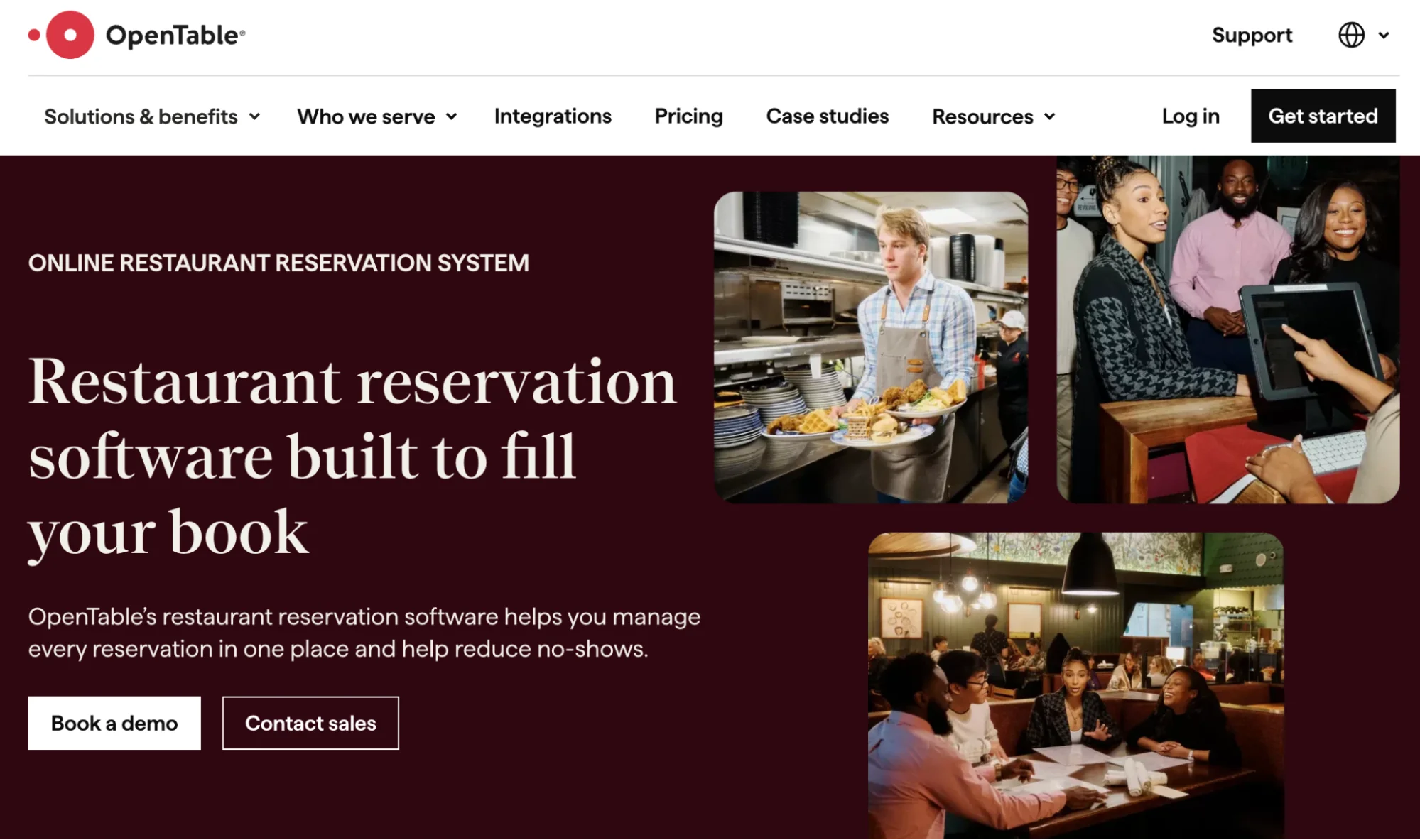
OpenTable is a restaurant booking system with a diner marketplace built in. Its app and website let diners search for restaurants and book tables across its network.
That network is a major reason restaurants choose OpenTable, but it also makes guest data worth looking at closely. In the UK, the platform offers two plans: Core and Pro. Both include POS integration, a guest database with tags and notes, a booking widget and review management. Pro adds 360 guest profiles, automated guest tagging and email campaigns.
Bookings made through your own website, by phone or from walk-ins carry no cover fee. Reservations from diners who find you through OpenTable's app or website are charged per seated cover. The platform also offers 24/7 support. For a closer look at the platform and its competitors, see our guide to OpenTable alternatives.
Best for: Restaurants looking to attract new diners through the reach of an established booking marketplace.
Limitation: Per-cover fees increase with the number of bookings you receive through the marketplace. There's also a trade-off around guest relationships: diners who discover you through OpenTable are managed through its platform, which can leave you with less control over how that relationship develops.
3. ResDiary

ResDiary is a UK-built booking and table management system, part of The Access Group since 2023. It's used by more than 11,000 venues worldwide.
Its booking rules are designed for venues with multiple spaces. Smart rules manage how guests are distributed across different areas, while yield management lets operators set availability by covers and time slots. For a pub with a dining room, bar and garden, that means each space can be managed separately to make the most of available tables.
Bookings are commission-free, including those made through Google Search and Maps. Deposits, prepayments and pre-orders also help reduce no-shows. Plans are based on monthly booking volume, with more than 70 certified EPOS and PMS integrations and a UK-based support team.
Best for: Pubs, hotels and multi-area venues looking for commission-free bookings and local support.
Limitation: CRM, marketing and some integrations come at an additional cost. This means building a more detailed guest profile requires extra investment, and the CRM offering is less comprehensive than that of platforms which focus on guest data.
4. TheFork

TheFork is a restaurant booking marketplace owned by Tripadvisor. TheFork Manager is the booking software restaurants use to manage reservations behind its marketplace.
Originally launched in France as LaFourchette, TheFork lists restaurants across Europe and reaches travellers planning where to eat through Tripadvisor. TheFork Manager brings bookings from TheFork, Tripadvisor, Google, MICHELIN, Meta and your own website into one diary.
It also includes table management, a centralised guest database and promotional tools. Restaurants get seven-day support and a dedicated account manager. Bookings through your website, Instagram and Facebook are covered by the subscription, while bookings from TheFork, Tripadvisor and partner sites incur a fee based on the average bill per guest.
Best for: Restaurants in tourist areas looking to attract diners through TheFork and Tripadvisor.
Limitation: The marketplace fee increases with average spend per guest, meaning higher-value bookings cost more. There's also a trade-off around guest data ownership: diners who discover your restaurant through the app start their relationship with TheFork rather than directly with you.
Compare each pricing model against your busiest month, not your average one. Per-cover and per-guest fees increase with every booking, while a flat subscription stays the same. At higher volumes, a platform with a lower starting price can end up costing more.
5. simpleERB

simpleERB is a UK-based cloud booking and table management system designed for smaller venues.
It focuses on the essentials, making it a good fit for restaurants that want a straightforward way to manage reservations. You can build your own table plans, create separate layouts for events and holidays, and drag and drop bookings across unlimited tables and areas.
Reservations come in through your website, Google, Facebook and Instagram. You can also securely hold card details to protect against no-shows, while automatic SMS and email reminders go out before each visit.
Contracts are monthly with no long-term commitment, giving you the flexibility to pause, downsize or upgrade as trade changes. The support team operates during UK business hours, with an urgent line for out-of-hours issues.
Best for: Independent restaurants looking for a simple booking diary they can set up and start using quickly.
Limitation: The platform focuses on reservation management rather than guest engagement. While it includes a customer database, there's no built-in marketing beyond automated reminders, and EposNow is the only listed POS integration.
6. resOS

resOS is a Copenhagen-based booking system used by more than 3,000 restaurants. It also offers a free plan for venues just starting to take online reservations.
There are no per-booking, per-cover or commission fees. Once you outgrow the free plan, you move to a flat monthly subscription, with paid tiers based on booking volume.
The core features cover the basics, while many of the tools busier restaurants need are available as add-ons. These include online payments for deposits, prepayments and no-show fees, Reserve with Google, a waitlist, SMS confirmations and experiences. Personal support is included with every plan.
Best for: Independent restaurants that want to test online bookings before committing to a paid system.
Limitation: The free plan is limited to 25 bookings per month. There's no listed POS integration, meaning guest profiles don't include spend data. Marketing also relies on an external tool such as Mailchimp rather than working directly from booking and guest activity.
7. DesignMyNight

DesignMyNight is a UK discovery platform for bars, restaurants and nights out. Its booking system powers reservations and event enquiries for venues on the platform.
Founded in London in 2011, DesignMyNight (DMN) became part of The Access Group in 2017, making it part of the same group as ResDiary. DMN is designed for venues where group bookings and events make up a large part of revenue. It includes enquiry management, function sheets, deposits, group pre-orders, table mapping, gift vouchers and ticketing.
On the consumer side, DesignMyNight says it promotes venues to up to 3.9 million monthly visitors. DMN is priced per site, with an additional fee for bookings generated through the platform, charged per confirmed booking or through a referral bundle.
Best for: Bars, restaurant groups and high-volume venues that rely on group bookings, parties and events.
Limitation: The platform is built around enquiries, events and larger parties. Restaurants that mainly serve smaller tables may end up spending a significant amount on features they rarely use. CRM capabilities are also not clearly outlined on its website, so ask to see a complete guest profile during the demo.
8. Eat App

Eat App is a restaurant booking and CRM platform used by more than 5,000 restaurants across over 90 countries, according to the company.
Bookings through your website, Google and social profiles are commission-free, with fixed pricing and no per-cover fees.
Guest profiles bring together visit history, preferences, tags, notes and spend, giving teams a clearer picture of who is dining with them. Email, SMS and WhatsApp messaging are also built into the platform, alongside deposits and prepayments on every plan.
The Pro plan adds POS integration and a shared guest database across multiple venues. Restaurants on lower tiers can access these features as paid add-ons.
Best for: Mid-sized restaurants and growing groups that want guest profiles and direct messaging in one booking platform.
Limitation: POS integration and the more advanced marketing features require the top-tier plan or an additional fee. Eat App is also headquartered outside the UK, so check that its support hours cover the times your team is most likely to need help.
How to choose a restaurant booking system
By now, you probably have a couple of systems on your shortlist, and all of them can handle a reservation. The real differences come down to what happens around the booking: what you pay at the end of a busy month, what you learn about your guests, how you manage the relationship with them, and how quickly you can get help if something goes wrong during service.
You'll see these platforms described as restaurant booking software, reservation software or simply booking systems. The terminology varies, but the important differences come down to how well each one handles the things that happen before and after a guest makes a reservation.
What to compare before you commit
Pricing is the easiest place to start, but it's also where headline rates can be misleading. Work through these points to understand what each system will actually deliver.
- Fee model: What would you pay at your actual cover volume in December, rather than at the advertised rate? Do payment gateways add separate charges for deposits?
- Guest data: Who owns the guest database, and can you export it with visit history, notes and spend data intact?
- POS integration: Does the system connect to your current POS, and what information will be missing from guest profiles without that connection?
- Marketing: Can email and SMS campaigns use the same guest profiles, or do you need to sync data from another tool?
- No-show protection: Can you set deposits, card holds and no-show fees based on the date, time or party size?
- UK support: Does support cover Friday and Saturday service, and does the team understand UK trading patterns, from bank holiday weekends to the Christmas party season?
Marketing deserves more attention than a feature checklist might suggest. UK diners are willing to hear from the restaurants they book with. According to the SevenRooms 2025 UK Restaurant Trends Report, 89% of customers would sign up for restaurant marketing, with 73% preferring email and 41% preferring text messages. Capturing a guest's contact details is only the first step. Your booking system should make it easy to put those details to use.
Recognition also gives guests an incentive to come again. In YouGov's Great Britain Dining Out Report 2025, 29% of British diners said a loyalty programme would make them more likely to return to a restaurant. That relationship can start with the booking itself, when a guest first shares their name and contact details with your team.
Questions to ask on the demo call
Ask every vendor these questions, in order, and pay attention to their answers. The differences often become clear by the third question.
- What will I pay per booking, and does the fee vary by booking channel?
- If I leave, which guest data can I take with me, and in what format?
- Does a walk-in automatically create a guest profile, or is a profile only created when someone books?
- Which bookings appear on your marketplace, and which come through my own channels?
- Are your POS integrations already working with my POS, or are they still on the roadmap?
- What support is available at 8pm on a Saturday if something goes wrong?
That last answer can tell you a lot about the service behind the software. A vendor offering weekend phone support and a named contact is giving you a clear route to help. One that points you to a help centre may leave your team searching for answers during a tricky service.
See it on your own floor plan
The best booking system is one that works for your team, makes life easier day to day and helps you get more from your guest relationships. Put the questions above to every vendor, SevenRooms included, and ask to see how your own floor plan, booking channels and guest data work together in practice.
Best restaurant booking system FAQs
What is the best restaurant booking system in the UK?
That depends on how many covers you take and what you need the system to do beyond managing reservations. SevenRooms brings bookings, guest profiles, POS data and marketing automation together in one platform, while other systems focus on commission-free bookings and local support or helping restaurants reach new diners through a marketplace. Think about what matters most to your operation and how much you want to do with your guest data.
How much does a restaurant booking system cost in the UK?
It varies by provider, plan and booking volume, and many vendors only share pricing on request. Pay attention to how you're charged: per-cover fees increase with every booking, while a flat monthly subscription stays the same regardless of volume.
What is a cover fee and which systems charge one?
A cover fee is a charge for each diner who books through a platform, usually when the reservation comes through the platform’s own marketplace. The more bookings you take through that channel, the more you pay. Some platforms charge a percentage of the average bill per guest instead, which means the fee increases with spend. The comparison table above breaks down how each system charges.
Can you switch booking systems without losing your guest data?
That depends on what your current provider lets you export. Basic contact details are usually easier to transfer than visit history, preferences, notes and spend data. Check exactly what you can take with you before signing up with a new provider.
Do you need a booking system if you take reservations by phone?
Yes. A booking system does more than record reservations. It can also keep guest details, visit history and preferences in one place, making it easier for your team to recognise returning diners and keep track of their needs.
Which booking system works with my POS?
Most of the eight platforms offer integrations with major POS systems, but compatibility varies. Check whether your specific POS is supported and whether the integration sends spend data back to the guest profile, rather than simply connecting the two systems.
