

If you're reading this, you're probably in one of two spots: taking reservations for the first time, or fed up with your current setup and weighing a switch. Either way, the hard part lies in picking which restaurant reservation software, because there are a lot of them.
Reservations went from nice-to-have to non-negotiable in about five years. Covid pushed nearly every restaurant online fast, and the tech rushed in behind it. Now your POS wants to run your bookings, delivery apps are adding on reservations and a dozen dedicated platforms all promise to fill your tables.
More options don’t make the decision easier. This guide cuts through the noise, comparing the seven best restaurant reservation systems of 2026 on what actually decides it for your business: who owns the guest data, what each booking really costs and how much the platform keeps doing for you after the guest leaves.
TL;DR
- The best restaurant reservation system goes beyond bookings, connecting guest data to CRM, marketing and reputation management in one platform.
- Guest data ownership is the biggest differentiator: marketplace platforms control the guest relationship, while direct reservation software keeps that data in your hands.
- No-cover-fee software protects margins by eliminating the per-booking charges many third-party platforms apply.
- Built-in prepayments and credit card holds for prepaid reservations cut no-shows and protect revenue before guests even arrive.
- For restaurant groups, deep POS integrations carry guest history, preferences and spend across every location.
Restaurant reservation systems covered in this guide
This guide reviews seven restaurant reservation systems and how they stack up on guest data ownership, booking fees, POS integrations, table management, marketing automation and support:
- Toast Tables
- OpenTable
- Resy
- ResDiary
- Yelp Guest Manager
- Hostme
Restaurant reservation systems comparison table
| System | Best for | Per-cover fees | Guest data | POS integration |
|---|---|---|---|---|
| SevenRooms | Guest data ownership and flexible marketplace reach | None | Direct bookings are first-party. DoorDash Reservations data stays with DoorDash | Toast, Square, Lightspeed, NCR and 100+ integrations |
| Toast Tables | Restaurants already on Toast POS | None | Basic guest profiles | Requires Toast POS |
| OpenTable | Network reach and discovery volume | On network reservations, under some plans | Marketplace platform that must be your primary reservation system | Core and Pro plans |
| Resy | Upscale and fine dining | None | Profiles with dietary notes, birthdays and visit history | Included from the Platform tier |
| ResDiary | A white-labeled guest experience | Flat-rate model | Stays with the restaurant | 70+ integrations |
| Yelp Guest Manager | Yelp-driven discovery on a budget | None | No guest profiles on the Basic tier | Plus tier and up |
| Hostme | Independents wanting an all-in-one platform at a flat rate | None on the core subscription | Stays with the restaurant | Lightspeed and Square on Grande |
How we evaluated these restaurant reservation systems
We looked at each platform the way an operator weighing a switch would. For every system we checked published pricing pages, integration documentation and support policies, verified as of the month this guide was last updated. Where a figure wasn't public, we've said so rather than guess.
The 7 best restaurant reservation systems for 2026
1. SevenRooms

Best for guest data ownership and flexible marketplace reach.
SevenRooms combines reservation management, table management, a CRM and marketing tools in one platform built for operators who want to own their guest relationships. It also powers DoorDash Reservations, which helps restaurants fill more tables and reach new guests.
Direct bookings are fully first-party, so the restaurant owns that data. Meanwhile, DoorDash Reservations add flexible marketplace reach, with DoorDash retaining that guest data as other marketplaces usually do.
Pros: Direct bookings and first-party guest data, paired with a DoorDash integration for marketplace demand. No cover fees on any reservation. Auto-tagged guest profiles for VIPs, regulars and big spenders, plus a booking widget in 14 languages. PCI-compliant prepayments, ticketing and upgrades in the booking flow. Voice AI that answers inbound booking calls without a script.
Cons: Pricing is custom-quoted rather than published, so you'll need to talk to sales for a figure.
Integrations: Reserve with Google, Toast, Olo and 100+ hospitality tech solutions, plus an integration with DoorDash online ordering (a DoorDash product, not a SevenRooms feature).
Support: 24/7, with 1:1 onboarding and training.
Pricing: Three packages with add-ons and no cover fees, quoted by sales.

2. Toast Tables
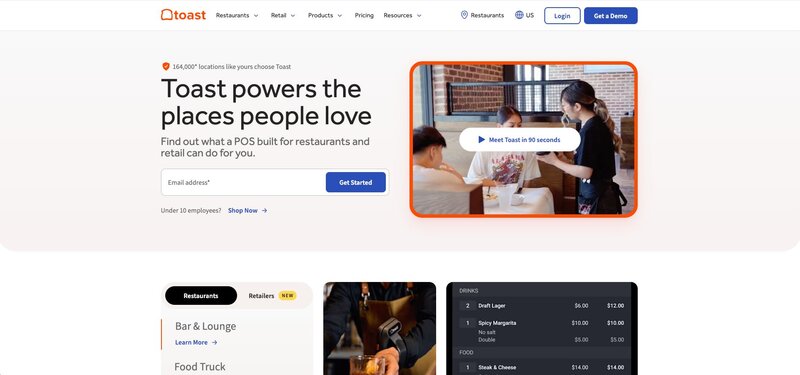
Toast Tables product page
Toast Tables is a reservation add-on for restaurants already on Toast POS, with bookings that sync to the POS in real time. If you're on Toast, it's a practical starting point.
Pros: Real-time table status sync with Toast POS. Reserve with Google integration. Basic guest profiles and loyalty sign-ups for integrated loyalty programs.
Cons: Requires Toast POS, with no standalone option. Guest-facing booking pages are Toast-hosted and co-branded with limited customization. Thinner CRM depth compared to other systems.
Pricing: A monthly add-on to a Toast POS subscription, with no per-cover fees and package options for different seating policies. Toast doesn't publish its rates, so you must contact the company directly for a quote. Integrates with Toast POS and Reserve with Google, with 24/7 support.
3. OpenTable

Best for network reach and discovery volume
This software has the largest diner network on this list, something that’s genuinely useful when you need discovery volume fast. The trade-off is cost and control: cover fees apply on network bookings, placement is influenced by what you pay and your brand takes a back seat in guest communications, which is why many operators start by looking at OpenTable alternatives.
It’s worth noting that OpenTable's updated terms now require restaurants to make it their primary reservation system, forcing manual re-entry of guest data from other providers, as Restaurant Business reported.
Pros: Large diner network and marketplace. Full reservation, table and waitlist management. 24/7 support.
Cons: Cover fees on network reservations under some plans. Placement influenced by spend level. Booking flows and emails are heavily OpenTable-branded.
Pricing: Basic $149, Core $299, Pro $499 per month, plus per-cover fees of roughly $1 to $1.50 on network reservations. Integrates with Google and Meta ad channels and a 100+ site and app booking network, with POS integration on the Core and Pro plans.
4. Resy

Best for upscale and fine dining positioning
Resy runs on a flat-rate subscription with no per-cover fees, a step ahead of OpenTable on cost predictability. Its marketplace skews toward larger cities and fine dining, so discovery value varies a lot by market. Since 2026, American Express owns both Resy and Tock, and the two now share a single platform and plan lineup.
Pros: No per-cover fees on a flat-rate model. Guest profiles with dietary notes, birthdays and visit history. Event ticketing and post-visit surveys.
Cons: The reporting and analytics default to a 30-day window. Limited marketing automation without third-party tools. Booking flows are strongly Resy-branded.
Pricing: Flat-rate with no per-cover fees. Resy publishes its plans starting at $249 per month for the Platform tier, with Platform 360 at $399 per month. Integrations span POS, discovery, CRM and API, included from the Platform tier up.
5. ResDiary

Best for a white-labeled guest experience
ResDiary is a white-labeled, cloud-based platform with a Dish Cult diner network, a flat-rate model and guest data that stays with the restaurant. It covers the essentials, but thinner CRM depth and mixed ease-of-use reviews hold it back against others here.
Pros: Lightly-branded guest communications that keep your restaurant front and center. Guest data ownership with a flat-rate Dish Cult marketplace and 70+ integrations.
Cons: Limited guest-tag configuration and no profile photos. Basic marketing tools and mixed ease-of-use reviews.
Pricing: Tiered plans (Connect, Express, Pro, Ultimate) that vary by region and reservation volume. 70+ integrations, with dedicated local support.
6. Yelp Guest Manager

Best for Yelp-driven discovery on a budget
Yelp Guest Manager is basic by design, and the real draw is the marketplace. Where Yelp drives meaningful discovery, it's a simple, low-cost way for a small restaurant to start taking bookings, though most operators outgrow it quickly.
Pros: Large consumer marketplace with heavy monthly traffic. Basic waitlist and table management. iPad included on the Basic plan.
Cons: Thin CRM, marketing automation and integrations. No built-in payment processing. The Basic tier caps you at 500 covers a month and leaves out POS integration and guest profiles.
Pricing: Basic from $159 per month and Plus from $349 per month, dropping to $129 and $279 if billed annually, with custom Enterprise pricing and no cover fees. POS integration is included on the Plus tier and up, with Olo and Punchh on Enterprise.
7. Hostme

Best for independents wanting an all-in-one platform at a flat monthly rate
Hostme is a reservation, waitlist and table management platform that runs on a flat monthly fee.
It bundles reservations, events, a guestbook, online ordering and marketing campaigns into one system, which makes it a practical pick for independents and small groups that want broad functionality without marketplace fees.
Pros: Flat monthly pricing with no per-cover fees or commissions, plus a two-week free trial. Reservation deposits and cancellation fees to curb no-shows. Guest data stays yours.
Cons: A smaller discovery network than the big marketplaces. POS integration isn't on the entry tier. Some booking channels cost extra, with Facebook and Instagram at $15 per month.
Pricing: Flat monthly plans. Mezzo is $109 per month and Grande is $169 per month, with 10% off annually and custom Enterprise pricing for 10 or more locations. Reserve with Google is included on every plan, POS integration with Lightspeed and Square comes on Grande. 24/7 support. The core subscription carries no per-cover fees.
What to look for in a restaurant reservation system
Online reservation systems come in all shapes and sizes, and not all of them do the same job. A quality restaurant reservation system goes beyond bookings to cover waitlist and table management, marketing automation, and reputation management. Here's what separates the strong ones compatibility and support
Your reservation system is one piece of a wider tech stack, so choose one whose restaurant POS integrations cover your point of sale, your payment processing and the rest of your tools. Confirm onboarding, training and support hours before you commit. Restaurants run nights and weekends, and your support should too.
Restaurant reservation system pricing
Most platforms offer several packages and add-ons, and the price listed on a website is usually just a starting point. Compare the full picture: startup costs, monthly fees, cover fees and the add-ons you will use. A low headline price with per-cover fees can cost more over a year than a flat rate. Ask every vendor for the cost per cover at your own volume, not the plan price. That one number is what makes two quotes comparable. SevenRooms pricing is set out by plan so you can see what each tier includes before you ask for a quote.
Guest data ownership
Not every system gives you equal access to the data it collects. On marketplace platforms, guest profiles belong to the platform first. Direct booking works the other way around: every profile in your guest database, including visit history and dining preferences, is yours to keep. That's the reason a lot of operators shift from third-party to direct booking.
That ownership pays off when you put the data to work. According to the National Restaurant Association, 81% of diners who aren't already in a loyalty program would join one at a restaurant they love, and those programs run on exactly the guest data direct booking lets you keep: favorite orders, preferences and visit history you can turn into more personal service and repeat visits.
Restaurant table management software
Table management is where a reservation system either earns its keep or gets in the way, so look closely at how much control it hands you over the floor.
The strongest restaurant table management software lets you set custom seating rules by section and party size, see real-time table status synced with your POS and adjust availability on the fly mid-service.
That flexibility shows up on the bottom line. Research from Cornell's Nolan School of Hotel Administration found restaurants that allow flexible reservation timing can lift revenue by up to 21% versus rigid scheduling. Good restaurant waitlist management does the same for walk-ins, turning a crowded doorway into an orderly queue instead of a guessing game.
Revenue protection and guest retention
The best platforms keep working long after the booking is made. Attaching prepayment requirements or credit card holds directly to the booking flow protects revenue and cuts no-shows before the guest arrives, which is the whole logic behind restaurant reservation deposits. Handled well, a booking that used to vanish becomes a chance to turn no-shows into regulars.
The marketing should keep going after service ends, too. The real win is capturing each new guest and converting them into a repeat, so look for a system that triggers welcome sequences, reservation confirmation emails and offers shaped by how a guest actually behaves, not by a static list.
It should also pull reviews from Google, Yelp and Tripadvisor into one dashboard so your team can respond without switching tools. That's how retention compounds: DoorDash and SevenRooms 2026 Restaurant Industry Trends Report shows repeat diners spend 27% more than first-time diners.
Choose the right restaurant reservation system for your operation
Most operators reading this are choosing between owning the guest relationship and renting reach. SevenRooms is built for the first, with flexible marketplace reach layered on top rather than traded away.
- Choose SevenRooms if you want to own your guest data, skip per-cover fees and layer flexible DoorDash Reservations reach on direct bookings.
- Choose Toast Tables if you already run Toast POS and mainly need bookings that sync with it.
- Choose OpenTable if discovery volume matters more than control and you can absorb per-cover fees.
- Choose Resy if you're an upscale venue that wants marketplace reach without per-cover charges.
- Choose ResDiary if a lightly-branded, white-labeled guest experience is your priority.
- Choose Yelp Guest Manager if Yelp drives your local discovery and you want a low-cost start.
- Choose Hostme if you want an all-in-one platform at a flat monthly price with no per-cover fees.
If guest data ownership and no per-cover fees are on your list, start with the best restaurant reservation system for keeping both, and compare everything else against it.
Boost your restaurant revenue and guest loyalty with SevenRooms
Ready to take control of your booking software and stop paying per-cover fees? SevenRooms' reservation system gives you direct-first bookings, integrated marketing and flexible DoorDash marketplace reach, all connected to guest data you actually own. Book a demo to see it on your floor.
Best restaurant reservation system FAQs
What booking system features are most important to use?
Confirming reservations with automated confirmations, planning seating, managing your waitlist and sending follow-ups are the essentials. Beyond the basics, automated marketing and guest tagging let you deliver a more personal experience at scale, turning one-time visitors into regulars without adding work for your team.
What are the two types of booking systems?
Third-party and direct are the two main types. Third-party platforms typically retain the guest relationship, while direct systems let restaurants keep their guest data and build that relationship themselves, without added fees or a middleman.
What are the benefits of online reservation systems?
An online restaurant reservation system keeps you and your staff organized, reduces wait times and prevents the mix-ups that frustrate guests and slow down service. The bigger opportunity is data: every booking is a chance to learn something about your guest and use it to improve their next visit.
Is there a reservation system that lets restaurants keep guest data?
SevenRooms is the strongest option for operators who want full ownership and control of their guest data. Unlike marketplace-driven platforms, SevenRooms doesn't remarket to your guests or share your data with third parties. Every guest profile in the restaurant CRM, including visit history, dining preferences and spend, belongs entirely to your business.
Which reservation system integrates best with restaurant POS systems?
SevenRooms integrates with 100+ hospitality platforms, including POS systems like Toast, Square, Lightspeed and NCR. Every transaction feeds directly into a guest profile, unifying spend history, order preferences and visit frequency in one place. For multi-location groups and hotel F&B operations, that depth of restaurant POS integrations is what makes consistent, personalized service possible across every property.
Note: All figures in this article were verified as of July 23, 2026. Data may have changed since publication.
