

A reservation platform knows about your guests, from who booked and who walked in to what they ordered and whether they came back. But who gets to keep all that knowledge and how easy is it to get them back? For operators working with Resy, that question has lately led to the search for an alternative.
With Resy, the booking data belongs to a third-party marketplace, which means the relationship with each guest is shared with the platform that sent them. For operators who already want more from their guest data, this might be a good moment to look at the options.
That's what this article looks at: the best Resy alternatives and how they handle your guest data, from reservations and walk-ins to POS checks. The right platform should give your team the information to recognize regulars, build relationships with new guests and give first-timers a reason to return.
These are the seven Resy competitors US restaurants are most likely to put on a shortlist:
- SevenRooms
- OpenTable
- Tablein
- Eat App
- Yelp Guest Manager
- SpotOn Reserve
- Toast Tables
On this list, you'll find full reservation platforms with built-in CRM and marketing tools, lighter booking tools and two systems built around their own POS, each compared on pricing model, guest data, POS integration, built-in marketing and the size of restaurant it suits. You may also find our guides to the best restaurant reservation systems and choosing a restaurant CRM helpful.
Resy alternatives comparison table
Start with the guest data column. It's central to the decision to switch, and it's where the Resy alternatives differ most.
| System | Pricing model | Guest data | POS integration | Marketing | Marketplace | Best for |
|---|---|---|---|---|---|---|
| SevenRooms | On request, no cover fees on direct bookings | Guest profiles from bookings, walk-ins and POS spend, with tags and segmentation | More than 65 POS integrations | Email, SMS, marketing automation | DoorDash Reservations, commission-free in a growing number of cities | Upmarket restaurants and multi-venue groups |
| OpenTable | Subscription plus per-cover fees on network bookings | Profiles on all plans, network diners book as OpenTable users | Yes, all plans | Automated email campaigns | OpenTable diner network, with per-cover fees | Discovery and network reach |
| Tablein | Flat monthly tiers by booking volume | Guest CRM with tags and export | Listed as coming soon | Via Mailchimp or MailerLite | No own marketplace, bookings through Reserve with Google | Small independents |
| Eat App | Subscription, commission-free bookings | Guest profiles and a searchable CRM | Pro plan, add-on below | SMS and WhatsApp included, email and automation as add-ons | No own marketplace, bookings through Google, Facebook and Instagram | Mid-sized, reservation-first venues |
| Yelp Guest Manager | Flat monthly, no cover fees | On request | Toast and other POS systems | Yelp listing and ads | Yelp, plus Reserve with Google and Apple Maps | Walk-in-heavy venues where Yelp drives traffic |
| SpotOn Reserve | Flat monthly add-on to SpotOn POS, no per-cover fees | Notes and VIP tags shared across locations | Native to SpotOn POS | Mailing list builder, text surveys | No own marketplace, bookings through Google | Restaurants already on SpotOn POS |
| Toast Tables | Flat monthly, no per-cover fees | Notes and visit history sync to Toast POS | Native to Toast POS | Two-way guest SMS | Toast Local app, commission-free | Restaurants already on Toast POS |
Information comes from each vendor's website as of November 2026. Where pricing or details aren't publicly available, we've marked them as "on request."
The 7 best Resy alternatives
1. SevenRooms

SevenRooms is a reservations, CRM, operations and marketing platform for restaurants, restaurant groups and hotel F&B, with the guest profile at its core.
Its reservation and waitlist system and table management work together, giving hosts one place to manage bookings, walk-ins and the waitlist. An AI-driven seating algorithm evaluates more than 10,000 seating options every second, helping teams keep service moving on busy nights without having to constantly rearrange the floor plan.
The CRM brings everything together. Guest profiles update automatically with information from reservations, walk-ins, events and integrated POS transactions. More than 65 POS integrations, including Toast, Square and SpotOn, bring in lifetime and itemized spend. Before a party arrives, your team can see who's a regular, what they typically order and any details that can help shape their experience.
SevenRooms’ CRM also makes it easier to group guests in ways that are useful for marketing. Your team can add unlimited tags, while Auto-tags apply them automatically using rules based on guest behavior, such as “positive reviewer” or “steak lover.”
From there, you can pull segments like big spenders or brand champions and use them to power email campaigns and loyalty programs. On Resy, this level of segmentation and automated email and text marketing typically relies on separate tools.
Marketing automation puts that information to work, sending targeted emails at the right moments. That could mean a thank-you after someone's first visit or an invitation to a regular who hasn't booked in a while, for instance.
Restaurants that rely on Resy or Tock for prepaid dining experiences can also use SevenRooms Events and Experiences, where guests can book tickets for special sittings alongside standard reservations. Each ticket holder is added to a guest profile, giving your team more context for a following visit.
Bookings made through your own website, Google and social channels carry no cover fee, and your restaurant retains ownership of the guest data.
Matū and Matū Kai in Los Angeles chose SevenRooms to keep the guest relationship in their own hands. "Our relationship is with the guest, not with a marketplace. We treat SevenRooms like a true CRM: we take detailed notes and use that information to personalize service," says co-founder Michael Odell.
For additional reach, SevenRooms powers DoorDash Reservations, which connects your tables to DoorDash's consumer network, one of the largest in the country. The service is commission-free and included with a SevenRooms subscription in a growing number of US cities.
Limitation: Pricing is available on request. Smaller, lower-volume restaurants may not use all the features SevenRooms offers.
2. OpenTable
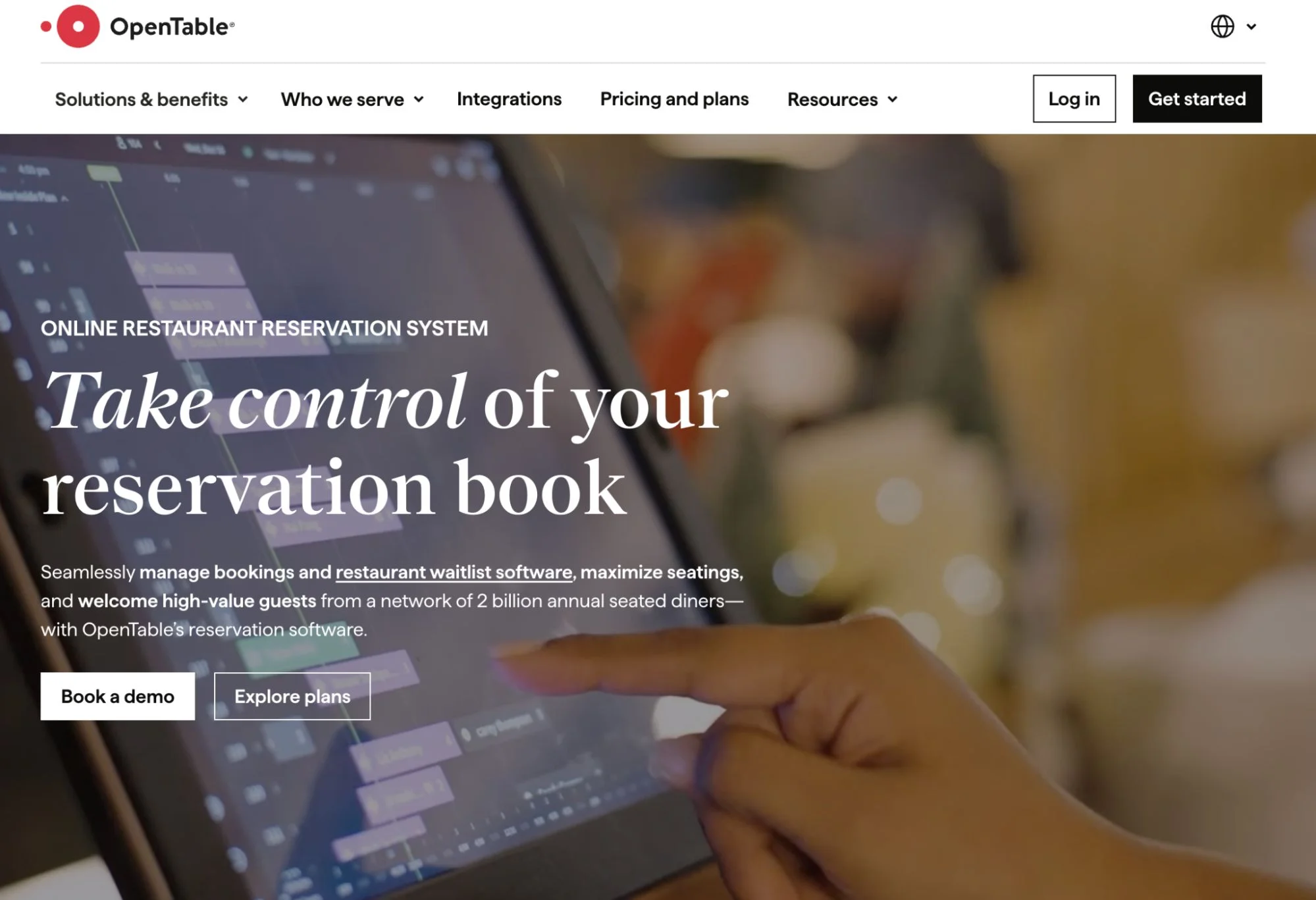
OpenTable combines a reservation platform and a diner marketplace: a consumer app and website where people can browse and book restaurants across its network.
When comparing Resy and OpenTable, reach is an important consideration. OpenTable lists more than twice as many restaurants as Resy. All three US plans include POS integration, a guest database with tags and notes and automated email campaigns.
On the Core and Pro plans, bookings from your own website or phone carry no cover fee. However, bookings from diners who discover your restaurant through OpenTable's network incur a per-cover fee. Our guide to OpenTable alternatives covers these trade-offs in more depth.
OpenTable's updated terms, effective April 16, 2026, introduce another consideration. Restaurants are asked to make OpenTable their "system of record" for reservations, table and guest management, as Restaurant Business reported.
These terms require restaurants to make availability shared with other platforms available on OpenTable. While OpenTable says restaurants can continue using other reservation systems, it's worth discussing this clause with your account manager if you take bookings across multiple channels.
Limitation: Per-cover fees for bookings through OpenTable's network can add up as demand grows. These diners also discover your restaurant through OpenTable, rather than your own channels, which can affect how much control you have over the guest relationship.
3. Tablein

Tablein is a restaurant booking system designed for smaller venues. It includes a booking widget, an online reservation book and a guest CRM.
It's light and simple to set up, with every feature included in each plan. Guest profiles carry tags and visit notes, restaurants can export their guestbook, and a waitlist helps capture demand when a date is fully booked.
Pricing is a flat monthly fee based on booking volume, while email campaigns run through integrations with Mailchimp or MailerLite. It's a good fit for independent restaurants that need online reservations without the complexity of a larger platform.
Limitation: POS integration is listed as coming soon. Without it, guest profiles don't include spending history, and are limited to basic reservation details.
4. Eat App

Eat App is restaurant reservation software with built-in CRM features, designed for mid-market restaurants. It offers a middle ground between simpler booking tools and more comprehensive platforms. Bookings are commission-free, and guest profiles store preferences, tags, notes and reviews.
Each paid plan includes an allowance for SMS and WhatsApp messages. POS integration is included with the Pro plan and available as an add-on on lower tiers. The same goes for email marketing and the automation suite. Eat App suits growing restaurants that want a guest database without the complexity of an enterprise-level rollout, provided the cost of the add-ons fits their budget.
Limitation: Many of the more advanced marketing and POS features cost extra. Without them, guest profiles may not offer the same depth of information as those on platforms built around CRM. Eat App also has no marketplace of its own, so new diners have to find you through Google, Facebook and Instagram rather than through a diner network.
Compare costs based on your busiest month, not your average one. Per-cover fees increase with every booking, while a flat subscription stays the same regardless of volume. At higher booking volumes, a platform with a lower starting price could end up costing you more.
5. Yelp Guest Manager

Yelp Guest Manager is Yelp's guest management software, designed to help restaurants manage their front of house. It brings reservations, waitlists and table management together in one iPad-based system at the host stand. Two-way texting helps teams communicate with diners, while credit card holds can reduce no-shows.
Restaurants can also make tables available through Yelp, Reserve with Google, Apple Maps, ChatGPT, Facebook and Instagram. All of this comes at a flat monthly price, with no per-cover fees. It's a good fit for restaurants that already get a steady flow of diners through Yelp, particularly those that rely on walk-ins and waitlists.
Limitation: Yelp Guest Manager makes the most sense when Yelp is already an important source of new diners. Yelp also doesn't clearly explain how much guest information restaurants can access from bookings across its different channels. Ask what data is shared with your team before assuming every booking gives you the same guest details as a direct reservation.
6. SpotOn Reserve

SpotOn Reserve is SpotOn's reservation and waitlist system, available as an add-on to its POS platform.With reservations and payments managed in the same system, there's no separate integration to set up or maintain.
Staff can add guest notes and tag VIPs, with those details available across every location. Guests can book through your website, Google and social channels, while a mailing list builder collects their contact details for future marketing. Pricing is a flat monthly add-on, with no per-cover fees.
Limitation: SpotOn Reserve is only an option if you already use SpotOn POS or are prepared to switch. Changing your POS is a much bigger undertaking than replacing your booking system, so it's worth weighing that commitment before making a decision.
7. Toast Tables

Toast Tables is Toast's reservation, waitlist and table management system, designed to work alongside Toast POS. Guest notes, special requests and visit history are available through the POS and server handhelds, while the floor plan shows which tables have already placed orders.
Guests can book through your website, Google or Toast Local, Toast's commission-free diner marketplace app. Restaurants can also collect prepayment for special experiences, such as wine dinners and chef's tastings. Pricing is a flat monthly fee, with no per-cover charges.
Limitation: Toast Tables requires Toast POS, so it's not an option for restaurants using another POS system unless they're willing to switch. Its reservation product is also newer than the standalone platforms in this comparison, which leaves it without the tried and true history to back it.
How to choose a new reservation platform
Every platform on this list can take a reservation. The real differences become clearer over time: what you pay as bookings grow and what information your team has about a guest when they return.
What to compare before you switch
Start with the data you'll take with you. You can renegotiate fees and vendors can add features, but guest history left behind in your old system takes time to rebuild. Every time a regular returns and your team has to ask questions they should already know the answers to, that missing information costs you.
- Pricing model: What would you pay at your actual booking volume during a busy month, rather than the advertised starting rate?
- Guest data: Which guest details, visit history and notes can you export from Resy, and in what format?
- Walk-ins: Does a walk-in create a guest profile, or does it only count toward that night's covers?
- POS integration: Do POS integrations add spending history to each guest profile? What information is missing without them?
- Marketing: Do email and text campaigns use the same guest profiles, or do they rely on data synced from another tool?
- Marketplace: Does the platform come with a diner marketplace to replace the reach you get from Resy, and what does it charge for bookings made there?
Questions to ask on the demo call
- What do I pay per booking, and does that change by channel?
- If I leave, what guest data do I own, and in what format?
- Which of my covers show on your marketplace, and which stay mine?
- Does a walk-in become a guest profile, or only a booking?
- Does it integrate with my POS today, or is that a roadmap item?
- Is reliable customer service available at 8 p.m. on a Saturday if something breaks?
The best Resy alternative is the one that gives you the strongest answers to these six questions.
Moving away from Resy without giving up its bookings
Moving away from Resy doesn't have to be all or nothing. Some restaurants still get valuable bookings through its marketplace and don't want to lose them, even when they want more control over their guest data.
For these operators, the practical answer is to keep Resy as one booking channel while a different system becomes the place where guest information lives. That's what Channel Connect by SevenRooms is designed for. It connects reservation inventory and guest data across every major booking channel and syncs reservations between platforms in real time.
A booking made on Resy appears in SevenRooms automatically and availability updates everywhere without anyone re-entering it by hand. SevenRooms becomes the single source of truth, allowing your host stand to run service from one system instead of switching between two tablets.
This is crucial for the restaurant industry: the 2026 DoorDash and SevenRooms Restaurant Industry Trends Report found that 40% of US operators use four to five separate systems to run core restaurant operations, and each one is another place where guest information can get fragmented.
Since guest data comes across with each booking, the SevenRooms CRM can add those reservations to guest profiles, alongside walk-ins, events and POS spend. Over time, your team builds the visit history and notes it needs to recognize returning guests and market to them directly.
If you later decide to leave Resy entirely, SevenRooms can import your Resy guestbook, so the guest relationships you've built come with you.
See what you keep when you own the booking
The reservation landscape has changed, but your guest relationships shouldn't have to start over. See how SevenRooms builds a complete guest profile from the very first reservation.
Resy alternatives FAQs
Can you move your guest data off Resy?
You can usually move some of it. Basic contact details, such as names, phone numbers and email addresses, are generally easy to export as a CSV file that your new platform can import. Visit history, guest preferences, notes and spend data are harder to transfer and may not come with you. Before signing ask Resy exactly which data you can export and what format it's available in.
What should a restaurant look for in a Resy alternative?
Start with the pricing at your typical cover volume, who owns the guest profile data, whether walk-ins are automatically added to guest profiles and how well the platform integrates with your POS. These details will tell you more about how the system will work day to day than the feature list alone.
How long does it take to switch reservation systems?
Expect the process to take weeks rather than days. Most of the work involves moving data and getting your team comfortable with the new system, not installing software. Give staff time to practice managing reservations before the switch, and ask the vendor for a realistic timeline and a dedicated point of contact.
Will you lose bookings while you switch?
You shouldn't, provided you plan the changeover around your reservation book rather than the vendor's schedule. Run both systems side by side during the handover, make the switch outside your busiest periods and keep your old booking page live until the new one is ready to take reservations.
Does your restaurant need a marketplace at all?
That depends on how much of your business already comes through your own channels. Marketplaces help restaurants reach new diners, sometimes through card perks and loyalty programs, but that exposure comes at a cost, whether per cover or through a subscription. If most of your online reservations already come through your website, Google and returning guests, you could be paying a marketplace to bring in diners who would have booked directly anyway.
Who owns Resy?
American Express owns Resy. It acquired the platform in 2019 and bought Tock in 2024, later bringing the two platforms together under the Resy brand, as Restaurant Business reported. If your restaurant signed up before those changes, it's worth checking what your current plan includes, especially how much guest data you can access and export.
