

Bookings are growing in Australian cafés and restaurants, while walk-ins keep dropping, as Restaurant & Catering Australia's reported. More of every night's covers now start with online reservations. Choosing the restaurant reservation software behind that first click has become one of the most important decisions an operator can make.
Nowadays, most hospitality platforms offer some kind of online booking option, from dedicated restaurant reservation platforms to point-of-sale companies bolting a restaurant booking system onto their core product. But more options don’t make the decision easier.
This guide cuts through the noise, comparing six restaurant reservation systems operating in Australia in 2026 on the three things that decide it for a venue: who owns the guest data, what their pricing model is and how much the platform keeps doing for you after the guest leaves.
TL;DR
- A reservation system has to do more than fill tables. The stronger platforms feed guest data straight into CRM, marketing automation and reputation management instead of leaving each job to a separate tool.
- A direct booking platform usually lets you own your guest data. A marketplace keeps the diner relationship on its own side of the transaction.
- Fee models split the Australian market. Flat-subscription platforms charge no cover fees, while marketplace bookings can carry a per-cover charge on top of the monthly fee.
- Prepayments, deposits and card holds do their work before service starts, cutting no-shows and protecting the revenue a late cancellation would otherwise take with it.
- For groups running more than one venue, POS integrations are what keep guest history, preferences and spend consistent from site to site rather than being trapped in whichever location took the booking.
Restaurant reservation systems covered in this guide
This guide reviews six restaurant reservation systems relevant to the Australian market, compared on guest data ownership, booking fees, POS integrations, table management, marketing automation, CRM and AI capabilities and support:
- OpenTable
- Now Book It
- Toast Tables
- ResDiary
- Obee
How we evaluated these restaurant reservation systems
Every platform below was checked against the same factors: guest data ownership, fees and pricing model, POS and booking channel compatibility, table management depth, CRM and AI capabilities and revenue or retention features.
The 6 best restaurant reservation systems for 2026
1. SevenRooms

Best for guest data ownership and flexible marketplace reach
SevenRooms combines direct bookings, table management, CRM and marketing automation for operators who want to own their guest relationships.
It also powers DoorDash Reservations, giving restaurants a way to turn marketplace discovery into lasting guest relationships. Through DoorDash Reservations, operators can reach DoorDash’s consumer network with zero cover fees, then use SevenRooms Marketing Automations to re-engage opted-in guests and encourage repeat visits.
Pros: Full guest data ownership plus DoorDash-powered flexible reach. No cover fees on any reservation, direct or through DoorDash. Auto-tagged guest profiles flagging VIPs, regulars, allergies and big spenders.
Voice AI answers and books calls automatically, so a missed call during service doesn't cost a cover. AI client Insights pulls guest history into a staff summary before every shift. PCI-compliant prepaid reservations, deposits and upgrades built into the booking flow.
Cons: If you don't accept reservations, SevenRooms has more features than you may need if you’re only operating with a simple waitlist and floor plan tracking. Australian pricing isn't published, so you'll need to speak to the team for a quote.
Integrations: Reserve with Google, Facebook, TripAdvisor and POS platforms like Ordermate, Square and Lightspeed.
Support: 24/7, with onboarding and training.
Pricing: Multiple packages tailored to the venue, with no cover fees on any plan. Contact SevenRooms directly for Australian pricing.
Al Aseel, a 10-venue Sydney group, grew revenue 116% in one year after adopting SevenRooms, with prepayment revenue up 166% year on year. "I've used a lot of systems. None of the others are even close to SevenRooms," says Tim Claus, Operations Solutions Manager.
2. OpenTable
Best for reach and discovery volume
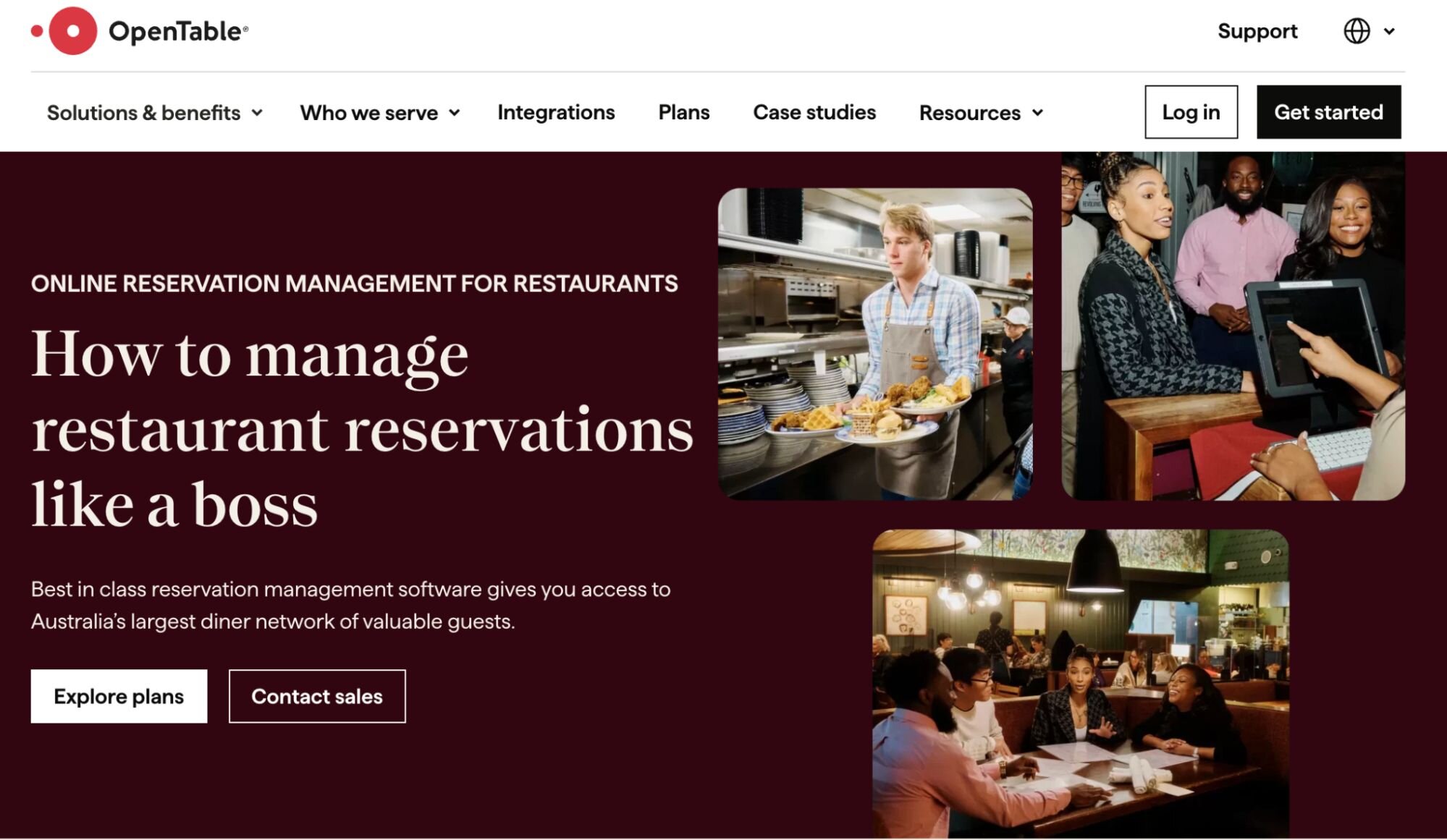
OpenTable AU is the Australian arm of the global restaurant discovery and booking network, and it has the largest diner network on this list, which is useful for a newer venue that needs discovery volume fast.
The trade-off is cost and control: OpenTable may charge cover fees on bookings diners make through its own site or app, while direct website, phone and walk-in bookings stay free.
Pros: Australia's largest diner network. Full reservation, table and waitlist management with offline operation during outages. Free direct, phone and walk-in bookings.
Cons: Cover fees apply on network-driven reservations, and guest-facing flows carry OpenTable's branding rather than the restaurant's. As reported by Restaurant Business, their updated terms of service now require restaurants to make OpenTable the system of record for reservation and guest data, which can mean extra setup for a venue running another platform alongside it.
Integrations: Specific Australian POS partners aren't published.
Support: 24/7.
Pricing: Not published for Australia. OpenTable AU directs enquiries to its sales team, and cover fees apply on network bookings.
3. Now Book It

Best for an AU/NZ-built platform with zero per-booking fees
Now Book It is a reservation and table management platform built for the Australian and New Zealand market, and it shows in the fee model: a flat monthly subscription with no per-booking or cover fees.
Its own site describes an automated CRM covering branded email and SMS campaigns, post-visit follow-ups, Google review prompts and gift card sales, plus Sadie, an AI receptionist marketed to answer calls 24/7 and take, edit or cancel bookings in real time, alongside AI-powered reporting for trends and staffing.
Pros: No per-booking or cover fees. Guest data covering spend, frequency, preferences and allergies. Automated CRM for repeat visits and gift card sales. Sadie handling 24/7 calls. Payments through EzyPay and Stripe with no added fee
Cons: Limited customisation on the booking widget, as well as limited reporting and data insights. No shared diner profile across venues. No dynamic floor management. No Google Business Profile integration. Pricing tiers and POS integrations aren't published, so confirm compatibility with your floor before committing.
Integrations: Payments through EzyPay and Stripe. Named POS partners aren't published.
Support: Marketed as around the clock, with a dedicated onboarding team.
Pricing: Flat monthly subscription with no per-booking or cover fees. Tiers aren't published.
4. Toast Tables

Best for venues already running Toast POS
Toast Tables is Toast's reservations, waitlist and table management product. The catch leads the list: it's sold as an add-on to an existing Toast POS subscription. Every other platform on this list runs standalone.
Pros: Guest data, table status and order status sync automatically with Toast POS. Guest profiles flag regulars, special occasions and waiting guests. Bookings direct from the venue's website, Google or the Local by Toast app. Can sell bookable, prepaid experiences, like a tasting menu guests pre-order and pay for at the time of booking
Cons: Only available as a Toast POS add-on, so it isn't an option on different point-of-sale software. Table management is limited. It's less established and less tested than the platforms built specifically around reservations. Has no features that focus on new customer acquisition. Toast doesn't publish separate Australian pricing for Tables.
Integrations: Toast POS, Google and the Local by Toast app. Not available on other point-of-sale software.
Support: 24/7.
Pricing: Sold as an add-on to a Toast POS subscription. No separate Australian pricing published for Tables.
5. ResDiary

Best for a lightly-branded, commission-free booking experience
ResDiary is a white-labelled, cloud-based platform that keeps guest-facing communications lightly branded, so the restaurant stays front and centre. ResDiary says the venue is the controller of its own guest data, and it doesn't charge commission regardless of booking source, including its own Dish Cult marketplace.
Its blog also describes ResDiary Evo, which auto-tags VIP diners, predicts no-show risk to trigger smart deposit prompts and summarises guest reviews with sentiment, plus a Copilot assistant for real-time service questions.
Pros: Lightly-branded guest communications. Commission-free bookings from any source. Evo's no-show prediction and smart deposit prompts, if the claim holds up in practice. 60+ technology integrations
Cons: It’s a browser-based system with limited feature updates and no table or floor plan optimisation. Back-end settings can't be adjusted by users, so every change has to go through support. Add-on features like SMS and POS integrations carry separate charges. Evo's AI claims are ResDiary's own marketing, without independent results published yet.
Integrations: 60+ technology integrations.
Support: Australian support hours aren't published, so confirm coverage for local trading times.
Pricing: Commission-free on bookings from any source, with add-on charges for SMS, POS integrations and other extras.
6. Obee

Best for a straightforward, Australian-built system
Obee is a Melbourne-founded reservation, table and restaurant waitlist management system, running since 2010 and used by 400+ Australian restaurants, bars and wineries. It doesn't publish any CRM or AI features on its own site. That's a plain factual gap rather than a knock, so weigh it if guest data depth is your priority.
Pros: Straightforward table and waitlist management without a big platform's learning curve. Card capture to secure bookings, per Obee's own positioning
Cons: It’s a basic system that captures reservation information, with identified CRM or AI features. Limited feature additions or product updates and support coverage. Operators need to speak directly with Obee to determine pricing, POS integrations and support hours.
Integrations: Not published.
Support: Not published.
Pricing: Not published.
What to look for in a restaurant reservation and booking system
A quality restaurant reservation system goes beyond taking bookings: it covers waitlist management, table management, marketing automation and guest retention long after the visit ends.
Compatibility and support
An online restaurant reservation system only earns its place if it fits the rest of your stack. Choose a system that integrates with your point-of-sale, payment processing and the other tools already running your floor, and confirm onboarding, training and support hours before you commit.
Restaurant reservation system pricing
Most restaurant booking software publishes a starting price and holds the rest back for a sales call. Compare total cost instead of the sticker price: setup fees, monthly fees, per-cover fees where they apply and any add-on charges for SMS, deposits or extra integrations.
Pro tip: ask every vendor for an all-in cost at your actual booking volume instead of the headline monthly fee. Cover fees, SMS charges and deposit processing add up fast once you're past a trial month.
Guest data ownership
On marketplace platforms, the guest profile belongs to the platform first. Direct booking platforms work the other way: every profile, including visit history and preferences, stays in the restaurant's own guest database.
Just 34% of operators say they can definitely recognise the same guest across dine-in and off-premise orders, while another 56% only think they can, according to a SevenRooms survey of 2,000 Australian diners.
Most of those venues are missing the single guest record that would let them use it, and ownership is what turns that record into revenue. 32% of Australian diners say they would pay more for a special occasion where the restaurant recognised them and knew what they were celebrating before they said a word. Own the profile outright and you are the one who can deliver that, not a marketplace that forwards you the booking.
Restaurant table management software
A table booking system fills slots. A restaurant table management software should hand you real control over your floor: seating rules by section, party size and time window, table status synced in real time with your POS and room to adjust availability on the fly.
Your floor also has to absorb the guests who never booked. 13% of Australian diners made their most recent restaurant booking by walking in, rising to 17% among Gen Z, and they make the call outside on the footpath. 84% rate a visible queue length as important when they are weighing up a walk-in and 80% want a posted wait time.
You cannot answer that honestly from a booking calendar. It takes a floor plan that shows real capacity in the moment.
SevenRooms' latest release adds Slot Mode, grid-based inventory control that lets a venue customise availability by table, time and party size, alongside Flexible Table Capacities that loosen or tighten table limits as demand shifts.
Revenue protection and guest retention
Deposits, card holds and prepayments cut no-shows before the guest arrives, and automated confirmations close the loop so nobody shows up on the wrong night. The strongest platforms keep working after service, turning a one-off booking into a regular.
That second half is where most Australian venues lose ground. 48% of operators name collecting guest contact information as their biggest obstacle to converting walk-ins into repeat customers, and 38% cannot reliably separate a first-time guest from a returning one.
Diners are not the obstacle here. 82% of Australian guests would hand over an email address or phone number after a walk-in, and half would do it for a discount or reward on their next visit. What they will not do is fill in a form for nothing.
Once the record exists, automated marketing keeps earning from it, with win-back offers and personalised invitations built on what the guest did rather than a generic list send. Australians want less fragmentation too: 55% would rather use one app for delivery, pickup and reservations than a different one for each.
Never miss a booking with SevenRooms
Every platform on this list can take a booking. The differences show up in what happens to the guest relationship afterward, and that's where SevenRooms pulls ahead for most Australian operators
Ready to stop paying per-cover fees and take control of your bookings? SevenRooms' restaurant reservation software gives Australian venues direct-first bookings, guest data ownership, integrated marketing automation and flexible DoorDash marketplace reach when you want it.
Restaurant reservation system FAQs
What is the best restaurant reservation system in Australia?
SevenRooms is the strongest all-round choice for operators who want to own their guest data and avoid cover fees, backed by direct bookings, table management and marketing automation in one platform. The right fit still depends on the venue: an AU/NZ-built platform like Now Book It or a discovery-first network like OpenTable AU can make sense depending on what you're solving for.
Do restaurant reservation systems charge cover fees in Australia?
Some do and some don't. OpenTable AU charges a cover fee on reservations diners make through its own network, though direct website, phone and walk-in bookings stay free. SevenRooms, Now Book It and ResDiary operate on flat fees with no cover charges on any booking.
Can I use SevenRooms in Australia without DoorDash Reservations?
Yes. SevenRooms works as a standalone direct-booking, CRM and marketing platform, and many venues run it exactly this way. DoorDash Reservations is flexible additional marketplace reach for venues that want it, not a requirement.
How much does a restaurant reservation system cost in Australia?
Pricing depends more on the fee model than the platform tier. Subscription platforms charge a flat monthly fee regardless of volume, while marketplace platforms often keep the monthly fee lower and add a cover fee per diner instead. Ask for the total cost at your actual booking volume before comparing.
What factors should I consider before picking a restaurant reservation system?
Look at five things: compatibility with your POS and other floor tools, total cost once every fee is counted and who owns the guest data it collects. Also weigh how much control you get over your tables and floor, and whether it keeps protecting revenue and bringing guests back after the booking is made.
Note: Every claim in this article was checked against the platform's own live pages where possible. Where verification wasn't possible, we've flagged it in the text rather than assumed.
