
Being ghosted hurts. Especially when you're a restaurant operator dealing with constant no-shows or last-minute cancellations. A table held for a party that never arrives is a staffed section and a paced kitchen you cannot recover the same night, which is why restaurants have stopped holding reservations for free.
At the same time, guest behavior is changing. Our research shows that most diners are comfortable sharing information when booking a table, and three in four say they're open to paying a restaurant reservation deposit. Whether you ask for one is a decision your restaurant reservation system should let you make slot by slot, not once for the whole book.
If you’re interested in charging reservation deposits but don’t know where to start, we’ll help you explore different approaches to introducing deposits and how to implement them without sacrificing experience.
Why restaurant reservation deposits protect revenue
Not long ago, free reservations were the norm. But as the dining landscape evolves, reservation deposits are becoming mainstream , and for good reason. They help restaurants alleviate revenue loss, reduce no-shows and combat emerging challenges like reservation hoarding, bots and reservation resale websites.
Restaurants that enact fairer, more reliable practices can help defend against casual diners who book ”just in case” reservations.
Prevent revenue loss
Every empty table during a prime dining hour represents lost revenue that cannot be recovered. A reservation deposit creates a financial commitment from guests, making it less likely they'll abandon their booking.
Even in cases where they don't show, you're not left with a total loss because you've offset part of the cost of holding that table.
Only 22% of US venues currently charge a cancellation fee, and those that do average $52. Most operators are still absorbing the cost of an empty table rather than pricing it.
This is especially critical for high-demand restaurants, holidays or special events, where a single no-show costs hundreds or thousands of dollars in missed revenue.
Reduce no-shows
Turning no-shows into regulars is the harder problem. A deposit solves the easier one first, because guests are more likely to honor a booking when money is on the line.
After no-shows climbed post-pandemic, Farmstead began taking reservation deposits through SevenRooms. Requiring prepayments cut no-shows and late cancellations from 15% to 1% overnight.
What is the ideal ratio for no-shows and cancellations? The global benchmark is 11% for cancellations and 3.5% for no-shows.
Reservation deposits cut the follow-up your host team is doing by hand
Fewer last-minute cancellations means a book a manager can actually plan against. Predictable covers let you forecast prep, roster to demand and order inventory against real numbers rather than a best guess.
Types of reservation deposit policies
There is no one-size-fits-all approach to reservation deposits. Here are several ways to go about them.
Reservation deposit
This approach involves charging a standard deposit, either per person or per party, to make a booking. You’ll need to secure payment details at the time of booking. The deposit can either be refunded when the party checks in or applied to the bill.
No-show and cancellation fees
If you ask for deposits, you can also implement a fee-based policy to protect against no-shows and cancellations. This allows you to retain the deposit collected at booking if guests fail to show up or cancel outside your stated policy window (for example, less than 24 or 48 hours before their reservation). Make your deposit refund policy clear during the booking process to avoid angry calls from customers.
This approach may feel more fair to diners, since they’re only charged if they back out late, while still protecting your restaurant from last-minute losses.
It also creates flexibility for loyal guests who may need to reschedule, helping you balance guest satisfaction and revenue security.
How much are restaurant cancellation fees? SevenRooms’ restaurant trends data found that average U.S. cancellation fees are $52. Check out our article on restaurant cancellation fees and deposits to learn more.
Prepaid booking
Another option is to require meals to be prepaid in order to hold a table. This approach works best for special events and prix fixe or multi-course menus, such as a chef’s tasting menu. Our restaurant event ideas include formats built for prepayment. You can add on prepaid wine pairings to generate even more sales.
Use a tool to introduce deposits without friction and help you generate revenue. A reservations platform, like SevenRooms, makes it easy to collect secure online payments for deposits, regardless of the strategy you choose.
Not sure which platform fits your operation? Our roundup of the best restaurant reservation system options covers the leading platforms side by side.
How to successfully implement restaurant reservation deposits
You may worry about guest pushback or fewer bookings when introducing deposits. But if implemented thoughtfully, the benefits outweigh the risks.
Decide when you want to charge deposits (you can be flexible)
If you’re nervous about introducing a new policy, consider easing into the process. Start small, test and expand once you see what works.
- High volume shifts and group bookings: Many restaurants apply deposits only for high-risk bookings — such as larger parties (six or more guests), peak dining times like weekends and holidays, or special events.
- Special events and dining experiences: Especially common for pre-fixe menus and fine dining experiences, prepaid bookings can help mitigate no-shows and reduce chargeback risks.
- Selective spaces: Some operators require deposits for premium areas, like private dining rooms or rooftop terraces, where no-shows hurt the most.
Ed Christmas, managing partner at Bums on Seats, a UK-based sales and marketing agency, notes that flexible policies reduce no-shows while encouraging more bookings:
“Setting up [flexible] cancellation policies for larger groups helps ensure these parties will show up, while removing the policies for smaller groups eliminates friction in the process. We’ve seen adjustments like these result in a 30%–40% increase in bookings.”
Proof in practice: The Island Quarter in Nottingham introduced card details for all bookings and deposits for large groups, generating £21,000 ($27,000 USD) in prepaid revenue within six months, and doubling prepaid reservations in one year.
Turn deposits into added value with upgrades and add-ons
A deposit can be a purchase rather than a penalty. Attach it to something the guest wanted anyway and it stops feeling like a hold on their card.
With a restaurant reservation system like SevenRooms , you can offer reservation upgrades and prepaid add-ons during booking, collected through secure online payments
Reservations carrying a prepaid upgrade spend 16% more per cover than reservations without one.
The appetite is already there. 30% of consumers would pay more for a special-occasion package, 25% for preferred seating and 24% for a limited-time menu experience.
The Island Quarter generated £33,000 ($41,000 USD) in prepaid revenue in six months, and doubled its reservations with prepayments across the year.
Create a refund and cancellation policy, then display it
The best reservations deposit policy is a transparent one. Avoid angry reviews from customers by clearly displaying your deposit policy. Make it an integral part of the booking process instead of hiding it in the fine print. Let guests know what they’ll be charged to hold a spot, and what the consequences are if they don’t show up or cancel at the last minute..
In your policy, clearly define and communicate the following:
- The deposit amount: Decide whether to charge a fixed amount, percentage, or fee per person or table. The amount should be high enough to deter no-shows but not so high that it deters serious customers. At SevenRooms, we typically see restaurants charging between $15 and $50 for a deposit.
- The cancellation window: Clearly state conditions under which the deposit is refundable, such as a full refund for cancellations made a certain number of days in advance. Choose a grace period that gives your team enough time to refill those tables.
For even more transparency, send confirmation emails and/or text messages for each reservation, and include the policy details. Reminder emails leading up to the booking can help reduce no-shows and cancellations.
Examples of restaurants using reservation deposits
These restaurants are masters at preventing revenue loss and reducing no-shows. Check out their deposit policies for inspiration.
All of these venues use SevenRooms’ direct booking reservations platform.
Duck & Waffle, London
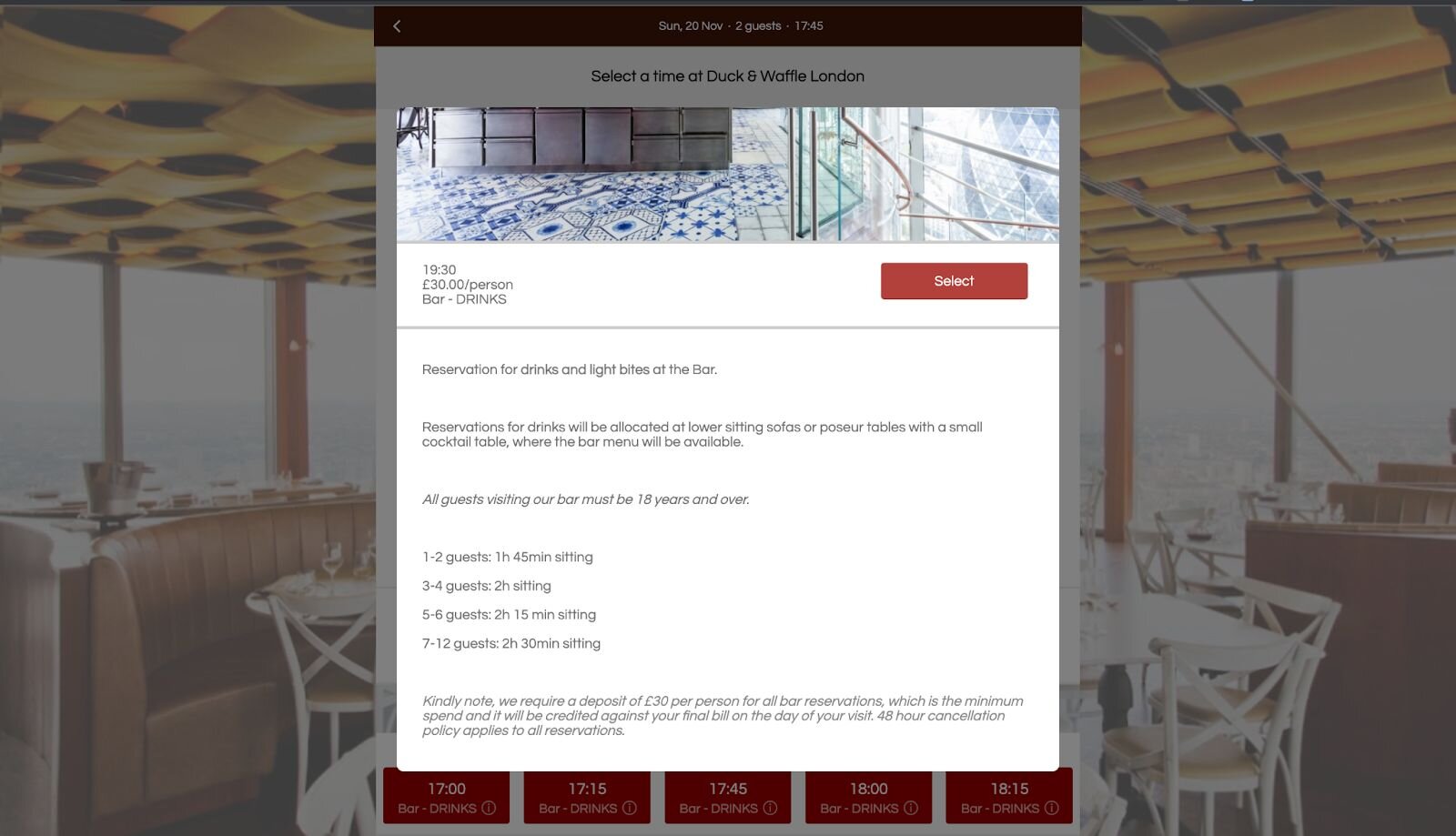
Duck & Waffle gives diners stunning views of London 24 hours a day from 40 stories up. To protect the business from no-shows, Duck & Waffle charges a £30 per person deposit that serves as a minimum spend and is applied to the final bill. This deposit isn’t refundable if the party becomes a no-show or cancels with less than 48 hours’ notice.
Machine Cocktail Bar, Chicago
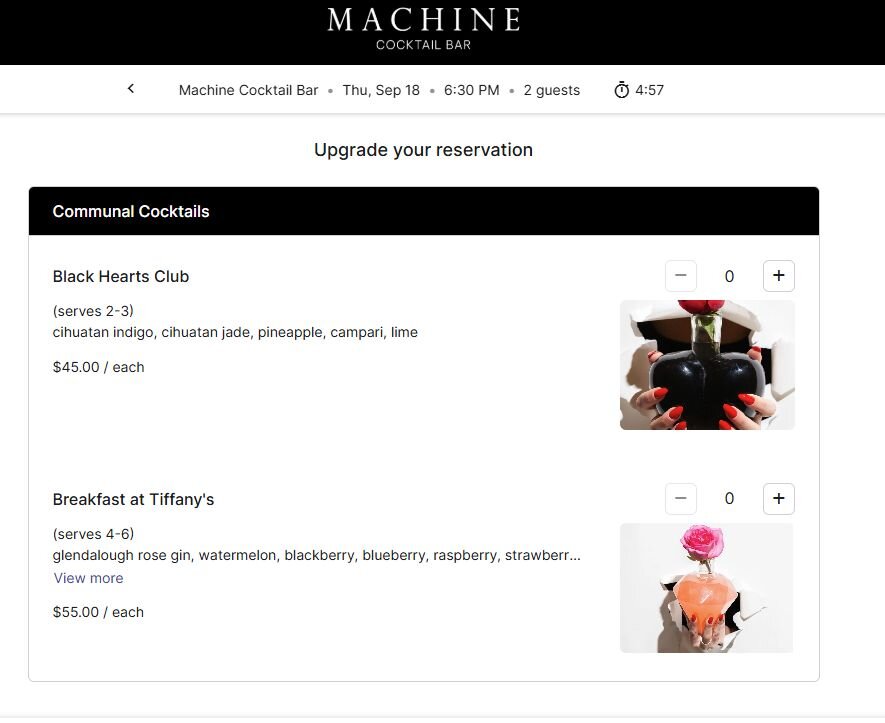
Machine Cocktail Bar is an elevated cocktail lounge in Chicago that gives guests immersive drink experiences in a stylish and intimate setting. At booking, the venue offers guests the opportunity to add a prepaid communal cocktail to their reservation, expertly paired with the menu, so guests can toast to the night ahead.
Quay, Sydney
Housed in the dress circle of Sydney Harbour, Quay is an award-winning restaurant serving up innovative cuisine inspired by the natural beauty of Australia.
Card details are required to dine with the group, and each booking page asks readers to scroll through its cancellation policies before securing a seat. For example, reservations canceled within 48 hours of the arrival time, or fail to show, are charged a $200 per person fee.
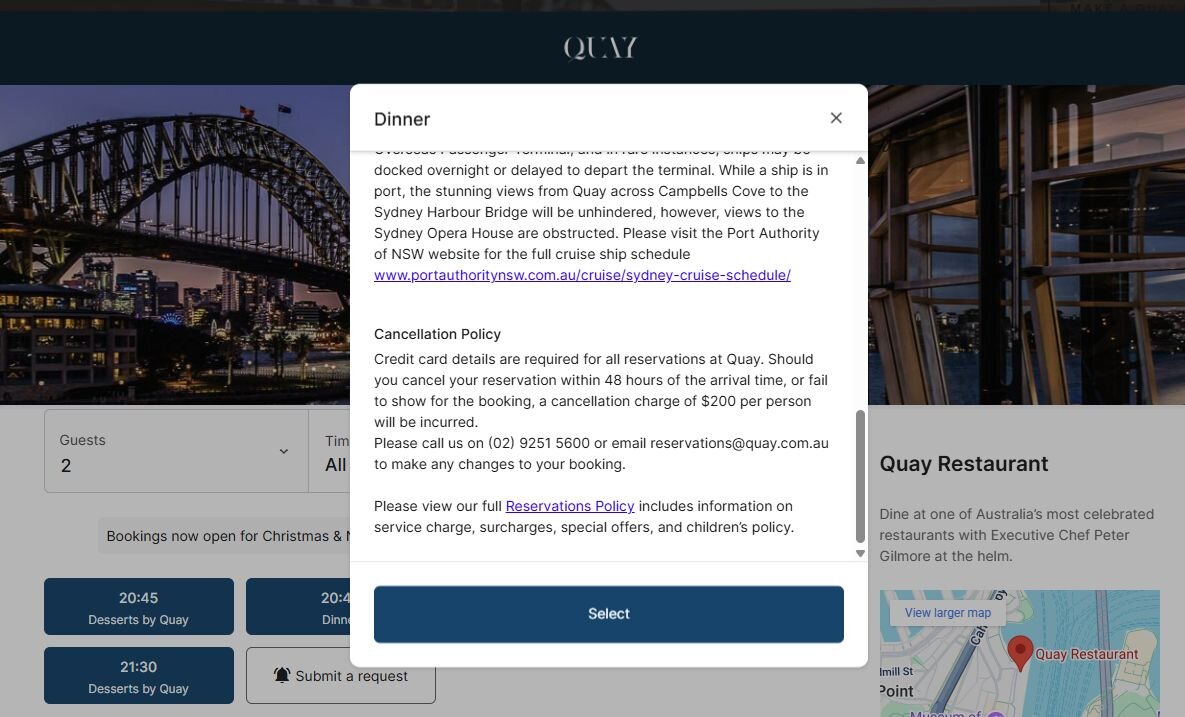
Prime-time seatings enjoy a 2.5-hour dining experience to savor one of two set tasting menus created by Executive Chef Peter Gilmore. Guests can also convey dietary requirements at this time.
A better, more intentional approach to reservations
Ten years ago, asking a guest to put a deposit on a reservation might have been a tough sell, but today, guests are willing to pull out their credit cards for booking restaurants they love.
Keep your deposit policy transparent and easy to find at the point of booking, and it protects the bottom line without costing you the reservation.
SevenRooms lets you set deposit and card-hold rules by party size, service or occasion, then collect and refund them at the point of booking.
Charge the deposit without losing the booking
Set deposit and card-hold rules by party size, service or occasion, and collect them at the point of booking.
Restaurant reservation deposit FAQs
1. How can I encourage customers to book with a reservation deposit?
Position the deposit as part of delivering a premium experience, not a barrier. SevenRooms research shows that three in four diners are open to paying a reservation deposit, especially when it secures access to special events, chef’s tables or limited-time menus. Make the policy clear, and highlight perks like priority seating, upgrades or exclusive menu access. Using a direct reservation system can also help ensure a smooth booking process.
2. Can restaurants require a deposit on reservations?
Yes, it’s actually becoming more common for restaurants to require deposits to hold a reservation, and most see deposits as fair — especially when they’re applied toward the dining experience. Reservation deposits protect against no-shows, which cost restaurants valuable revenue and disrupt operations.
3. How much should I charge for a reservation deposit?
Many restaurants charge anywhere from $10 to $50 per person, or a flat percentage (e.g., 20 to 30%) of the expected spend for high-demand reservations. The average U.S. cancellation fee is $52, according to SevenRooms’ latest restaurant trends data. Choose a deposit amount that aligns with your concept, average check size and type of booking.
