

The phone rings during Saturday dinner service, your host is mid-seating, your bartender is three cocktails deep and no one picks up. That missed call is likely a reservation, and in most restaurants, it's gone forever.
According to Nation's Restaurant News, 40% of restaurant calls go unanswered, yet 64% of diners still call to book, according to SevenRooms’ latest data report.
Short-staffed floors are a big reason why: a TD Bank survey of restaurant franchise leaders found labor shortages topping operator concerns for 2026, with 54% citing a shrinking labor pool as their biggest worry. When there aren't enough hands on deck, the phone is usually the first thing to go unanswered. In such a scenario, AI is the fix this industry is already ready for.
75% of diners are comfortable using AI for reservations but only 28% of operators have deployed it. AI phone answering for restaurants closes that gap, but plenty of operators hesitate before handing the phone over.
- Will a caller still feel like they're talking to their neighborhood spot?
- What happens when the AI hits a question it can't answer?
- How does it plug into the restaurant reservation system you already run?
This guide answers those concerns: what a restaurant phone answering system is, the seven worth comparing and how to choose between them.
What is a restaurant phone answering system?
A restaurant phone answering system picks up the calls your team can’t. It takes reservations, answers the questions guests ask every night and passes anything complicated to a person, so the phone stops competing with the guests standing in front of you.
There are three main types, and they solve the problem in different ways:
- AI phone answering: software that holds a natural conversation, checks live availability and books or changes reservations on the call, around the clock.
- Live answering services: a call center whose agents answer in your restaurant’s name and take messages or bookings, usually priced per call or per minute.
- Business phone systems: internet-based phone lines with call routing and a press-one menu, sometimes with an AI receptionist sold as an add-on.
Why restaurants use a phone answering service
- Fewer missed bookings: calls during the dinner rush and after close still get answered.
- Staff stay on the floor: hosts seat guests instead of reading out the hours for the tenth time that night.
- After-hours coverage: a guest can book at 11 p.m. without leaving a voicemail nobody returns.
- The same answer every time: hours, parking, dietary options and policies don’t depend on who picks up.
- Guest data from every call: the better systems save name, party size and requests to the guest profile, so the next visit starts with context.
Restaurant phone answering systems covered in this guide
This guide compares seven systems on AI call handling, reservation booking, guest data capture, CRM integration, multilingual support and pricing:
- SevenRooms Voice AI: best for turning every phone call into a guest relationship
- CloudTalk: best for multi-location call management
- Slang.ai: best for brand voice consistency
- Loman AI: best for full-service phone ordering on a budget
- Hostie.ai: best for absorbing peak call surges
- Smith.ai: best for a live human backup on high-stakes calls
- PolyAI: best for enterprise
Restaurant phone answering systems comparison table
| System | Best for | Type | Handles | Starting price |
|---|---|---|---|---|
| SevenRooms Voice AI | Turning every call into a guest relationship | AI, built into reservations and CRM | Reservations, changes, cancellations, guest questions | Quote-based |
| CloudTalk | Multi-location call management | Business phone system with AI add-on | Concurrent calls, routing, call analytics | AI Receptionist from $99/month (200 minutes), plus per-user plans |
| Slang.ai | Brand voice consistency | AI | Reservations and FAQs, with reservation integrations | $399/month per location |
| Loman AI | Phone ordering for independents | AI | Reservations, takeout orders, phone payments | Not published |
| Hostie.ai | Absorbing peak call surges | AI | Routine inquiries during peak hours | Not published |
| Smith.ai | A live human backup | AI receptionist with live agents | Routine calls, with handoff to a person | $150/month for 75 calls (free plan for 25) |
| PolyAI | Enterprise | AI, fully managed | High call volumes, custom call flows | Quote-based |
Prices as published by each vendor in October 2026. Check the vendor’s site before you buy, since plans change often.
How traditional restaurant phone answering systems have changed
Restaurant phone systems were built on automation and used to mean a script: you would press one for reservations, press two for hours, then a hold queue. Nowadays, however, a restaurant phone answering system is closer to a shift covered by software: an automated call handling layer or AI phone agent that takes reservations, answers menu questions and manages guest inquiries without tying up a staff member.
Modern systems run on conversational AI, not the touch-tone IVR menus they replaced, so they understand natural language, check live availability and confirm phone reservations in real time. They handle call routing, special requests and catering inquiries, improving order accuracy and reducing guest wait times even during high call volume.
The key question before choosing any system: does it write guest data to a CRM the restaurant owns, or just take a message?
1. SevenRooms Voice AI: best for turning phone calls into guest relationships
SevenRooms Voice AI for restaurants combines AI-powered phone answering with reservation and CRM integration, automatically writing every booked call to the restaurant's guest profiles. For restaurants with an existing POS integration, those profiles can also include order history, spend data and guest preferences for returning callers.
The key differentiator is that Voice AI is built directly into the SevenRooms CRM and reservations platform rather than operating as a standalone phone solution. Information captured during a call becomes part of the guest profile restaurants already use for reservations, CRM and marketing, eliminating the need for additional integrations.
David Chen, COO of Casper Hospitality, has witnessed this potential directly: “Since switching to SevenRooms Voice AI, we’ve practically retired our phones at all four of our U.S. locations. Every guest call is handled, no missed reservations, no staff interruptions. It’s freed up hours each week, letting our team focus on what really matters: our guests in the room.”
In one month, Casper handled over 3,800 calls, created 850-plus covers and generated $28k in booked revenue.
What it does:
- Answers inbound calls in natural language using natural language processing (NLP), no phone tree or scripted menu
- Captures party size, date, time and special requests in conversation
- Checks live availability and confirms reservations verbally
- Handles modifications and cancellations without staff involvement
- Writes all guest data directly to the restaurant CRM as first-party records
- Built directly into the SevenRooms platform, not a bolt-on integration
2. CloudTalk: best for multi-location call management
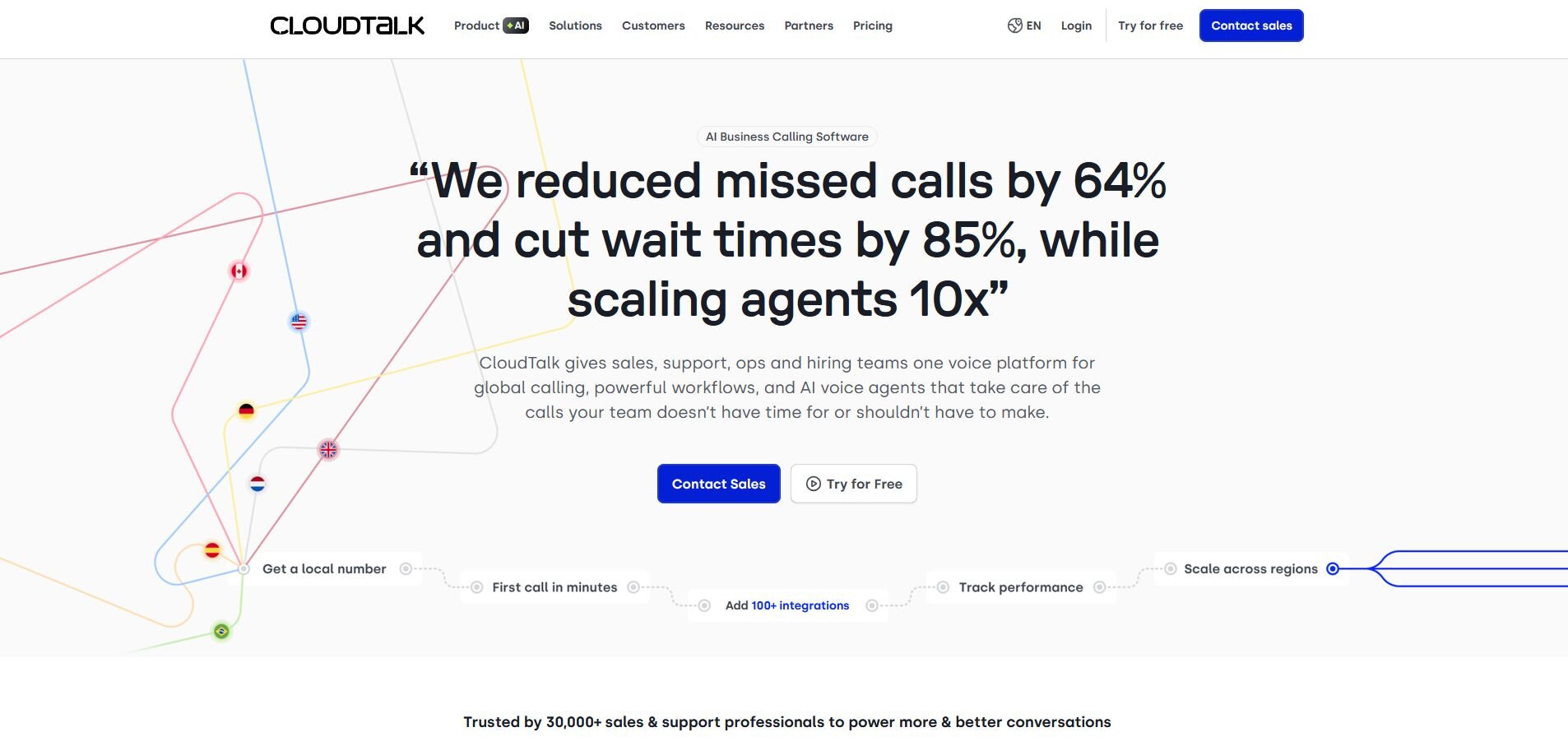
CloudTalk is a general business phone platform, not built for restaurants specifically. It runs on internet-based calling with AI that can handle several calls at once, which suits restaurant groups that want to manage calls across multiple locations from one dashboard. Just don't expect restaurant-smart data: any CRM connection works the same way it would for any business, not through hospitality-specific guest profiles. Its per-user pricing structure also makes it the lower-cost option here for a small team.
What it does:
- Handles concurrent calls across multiple locations from one dashboard
- Syncs with general CRM tools through standard integrations, not hospitality-specific guest data
- Provides call analytics and sentiment scoring
- Supports multilingual call handling
- Starting cost: per-user phone plans, plus the AI Receptionist add-on from $99/month for 200 minutes
3. Slang.ai: best for brand voice consistency
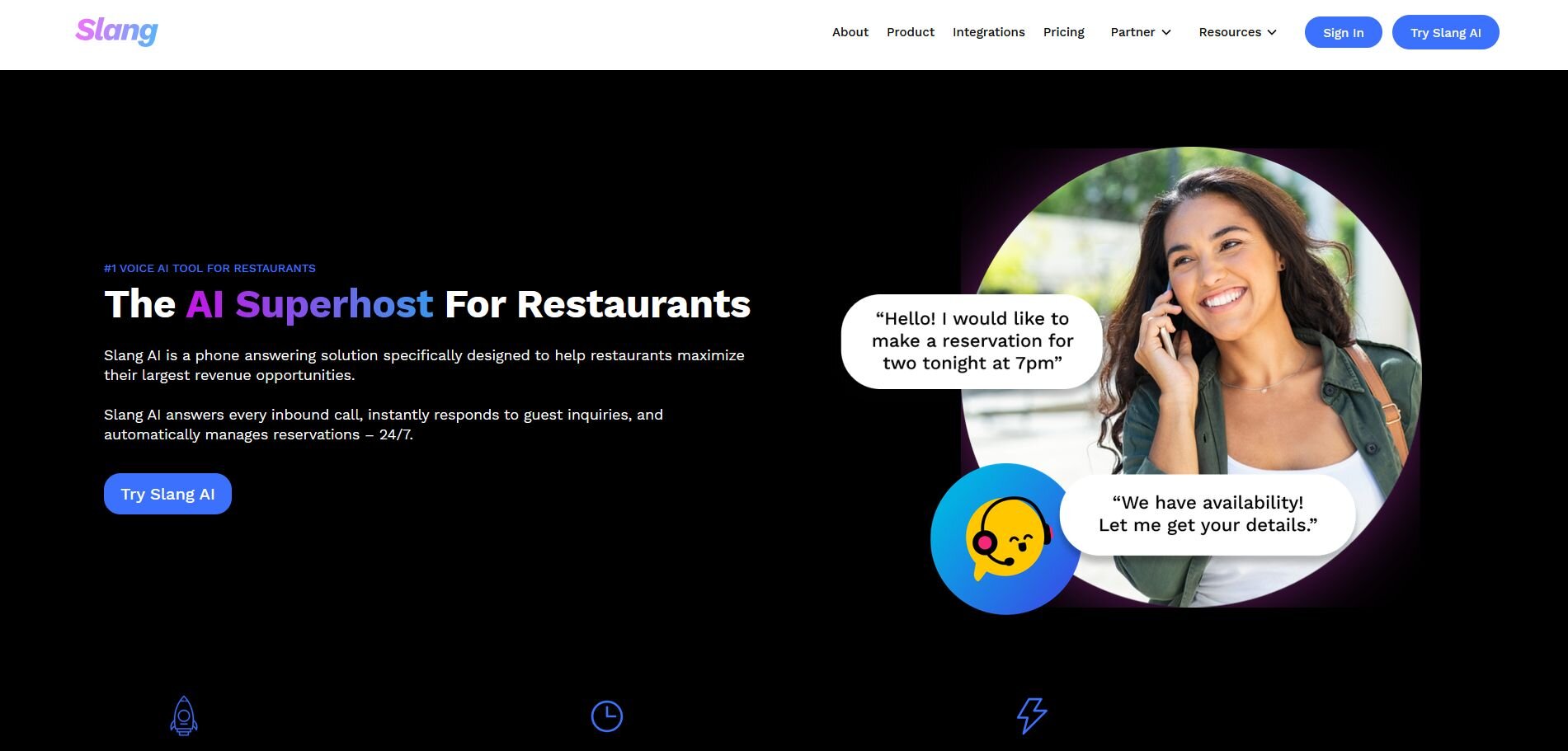
Slang.ai focuses on voice quality and brand voice customization, letting operators configure a virtual receptionist that sounds like a natural extension of their restaurant. It has confirmed integrations with SevenRooms and other major reservation platform providers.
What it does:
- Customizable AI voice tuned to match restaurant brand tone
- FAQ automation for hours, parking, dietary options and menu questions
- Integrates with SevenRooms, OpenTable, Tripleseat and Yelp
- Starting cost: $399/month per location for the Core plan, with Premium starting at $599/month per location
4. Loman AI: best for full-service phone ordering on a budget
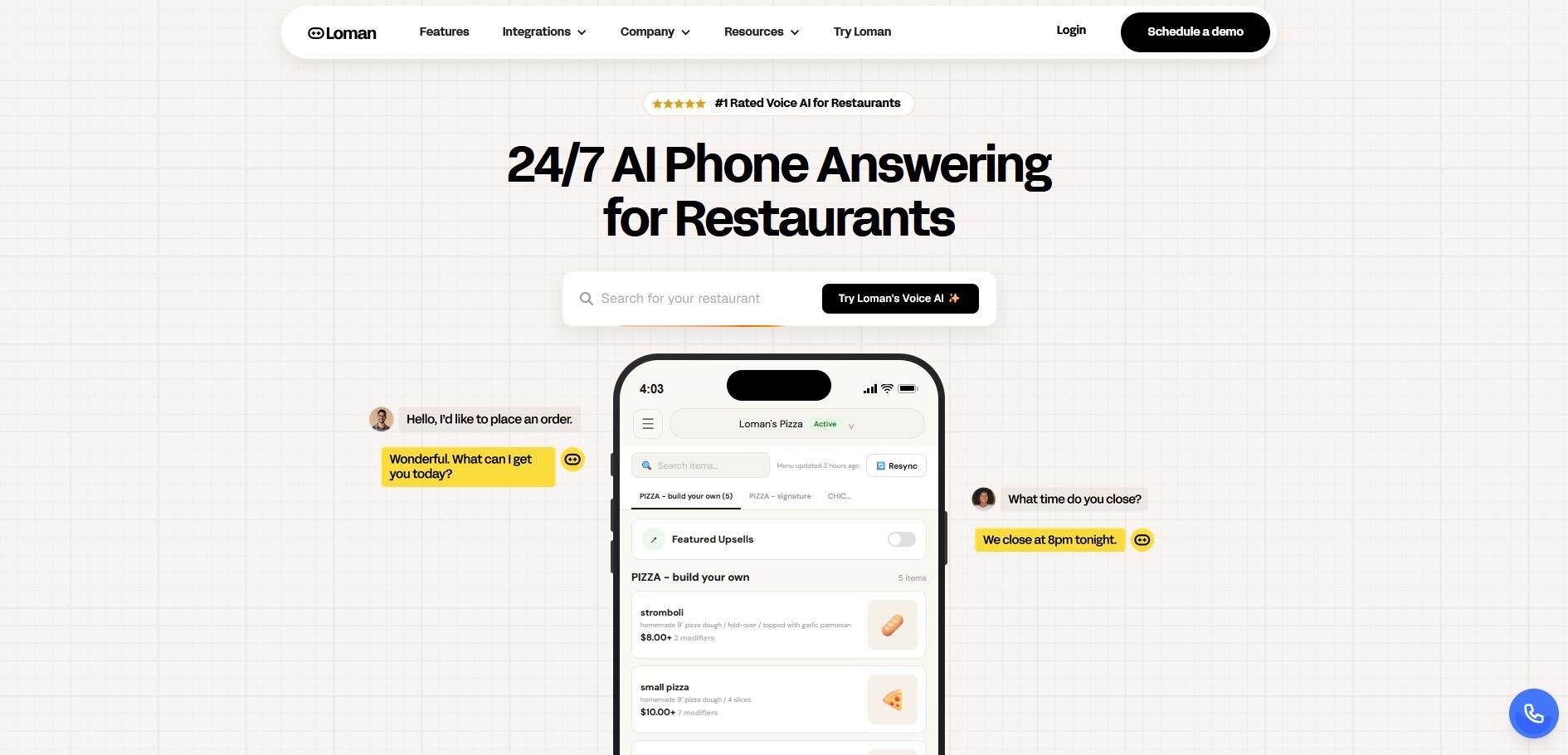
For independent operators who need 24/7 availability without enterprise pricing, Loman AI is an accessible starting point. It handles inbound calls for reservations, takeout orders and FAQ responses based on uploaded menu data, covering the basics a solo operator needs to stop missing calls during service. It also integrates with Toast, Square, Clover and OpenTable.
What it does:
- 24/7 call coverage for reservations and takeout orders, including modifiers
- PCI-compliant payment processing over the phone
- Integrations with Toast, Square, Clover and OpenTable
- Starting cost: not published; quoted after a demo
5. Hostie.ai: best for absorbing peak call surges
Hostie.ai is built for high-volume environments, absorbing call surges during peak call times so front-of-house staff can stay focused on the floor. It can suit restaurant groups managing multiple locations, where simultaneous peak hours create the highest call routing pressure.
What it does:
- Engineered for peak-hour call surge handling
- Routes routine inquiries away from floor staff
- Supports multilingual call coverage
- Starting cost: not published; quoted after a demo
6. Smith.ai: best for a live human backup on high-stakes calls
Smith.ai is a general business virtual receptionist service, not a restaurant-specific tool, pairing an AI receptionist for routine calls with optional live human backup for high-stakes guest interactions. That hybrid approach may suit fine dining establishments where a VIP caller's first impression needs a distinctly human touch, though its per-call pricing model can escalate at high call volume.
What it does:
- AI handling for routine calls with optional live agent handoff
- Bilingual coverage in English and Spanish
- General business virtual receptionist, not built specifically for restaurants
- Starting cost: $150/month for 75 calls on the Pro plan, with a free plan for 25 calls a month
7. PolyAI: best for enterprise

PolyAI is built for large restaurant chains with complex reservation management needs at significant scale, and is typically deployed for enterprise operators rather than independent or mid-market groups. Its pricing puts it out of scope for most operators evaluating an AI phone answering system for the first time.
What it does:
- Enterprise-grade concurrency for large call volumes
- Custom conversational logic for complex use cases
- Fully managed deployment and setup
- Starting cost: enterprise pricing, quote-based
How to choose the right restaurant phone answering service
Not every restaurant phone answering service is built the same way. These four questions below, drawn from reservation system priorities that matter to operators, narrow the field quickly.
Does it book the table directly, or just take a message?
Some systems capture caller details and hand them to staff for follow-up. Others confirm the reservation in natural conversation and close the booking without any staff involvement, but only if it actually connects to the reservation platform you already run. If you are still choosing that platform, start with our comparison of the best restaurant reservation systems.
SevenRooms Voice AI is built directly into the platform, no integration required, while third-party tools like Slang.ai and Loman AI plug into OpenTable or your CRM depending on the vendor. If the system doesn't complete the AI restaurant reservation autonomously and land it where your team already works, it's adding work rather than removing it.
Does it generate guest data that the restaurant owns?
Many AI phone answering services handle the call but write that data to their own systems, not the restaurant's. SevenRooms Voice AI is the only option here built into the reservation system and CRM itself, so every booked call lands in the same guest profile the team already uses, creating a first-party guest record the host team can act on at every future visit.
Can it handle peak-hour call volume without a busy signal?
A system that holds up on a Tuesday lunch needs to hold up during a Friday rush. If it can't manage concurrency at peak call times, guests hit voicemail and the problem it was supposed to solve comes right back.
Does it flex to how you actually run service?
A caller should still feel like they reached your restaurant, not a call center, so brand voice customization matters as much as call handling. SevenRooms Voice AI, for example, lets operators customize the voice and personality, hand off complex calls to staff and adjust coverage by shift, so the system flexes to service instead of the other way around.
Does it fit your size?
Solo operators get accessible 24/7 coverage from Loman AI. Multi-location groups needing centralized call management can look at CloudTalk or PolyAI. Operators prioritizing brand voice consistency have Slang.ai. Fine dining rooms that want a human backup option have Smith.ai. Any restaurant that needs first-party CRM data from every call, at any size, has SevenRooms Voice AI.
See how SevenRooms Voice AI captures every call and owns the data
Most restaurant phone answering systems stop at the confirmation. SevenRooms Voice AI goes further: every booked call writes to the guest CRM as first-party data your restaurant owns, not the platform. Add DoorDash Reservations for flexible marketplace reach and you have both demand sources covered from one system.
Restaurant phone answering system FAQs:
How does AI phone answering work in a restaurant?
A call comes in and, like other AI agents for restaurants, the system identifies the request type (reservation, order or FAQ) and handles it end-to-end: checking availability, capturing guest details, confirming the booking and updating the CRM without staff involvement. Unlike standard automation, an AI phone answering system understands natural language and modifications without a script, so there's no voicemail backlog and no missed calls during service.
Does SevenRooms have a restaurant phone answering system?
Yes. SevenRooms Voice AI answers inbound reservation calls, captures booking details in conversation and confirms the reservation verbally, then writes all guest data from that call to the SevenRooms CRM as first-party data owned by the restaurant, not the platform.
Which restaurant phone answering system is best for independent restaurants?
SevenRooms Voice AI is the strongest option for independent restaurants that want 24/7 availability with first-party guest data, since every call writes directly into the SevenRooms CRM the restaurant already owns. On a tighter budget, CloudTalk's per-user pricing can actually come in cheaper for a single location. Restaurants where brand voice is the priority may prefer Slang.ai. The question that matters most: does the system generate guest data the restaurant owns, or data the platform controls?
What is the difference between an AI phone answering and a standard answering service?
A standard answering service routes calls to a human agent or records a voicemail for follow-up, which means callbacks and staff time spent returning messages. An AI answering service handles the full interaction in real time and updates the reservation system automatically. Restaurant AI tools resolve the request on the call instead of deferring it, improving staff efficiency and eliminating missed phone orders during service.
How much does a restaurant phone answering system cost?
It depends on the type. AI answering tools usually charge a monthly fee per location: Slang.ai starts at $399 a month per location. Business phone systems charge per user and sell AI receptionists as add-ons, such as CloudTalk’s from $99 a month for 200 minutes. Answering services often charge per call, like Smith.ai’s $150 a month for 75 calls. Several vendors only share pricing after a demo, so compare the full cost at your real call volume.

